Awakenings

Glimpses of the Divine in the Mundane

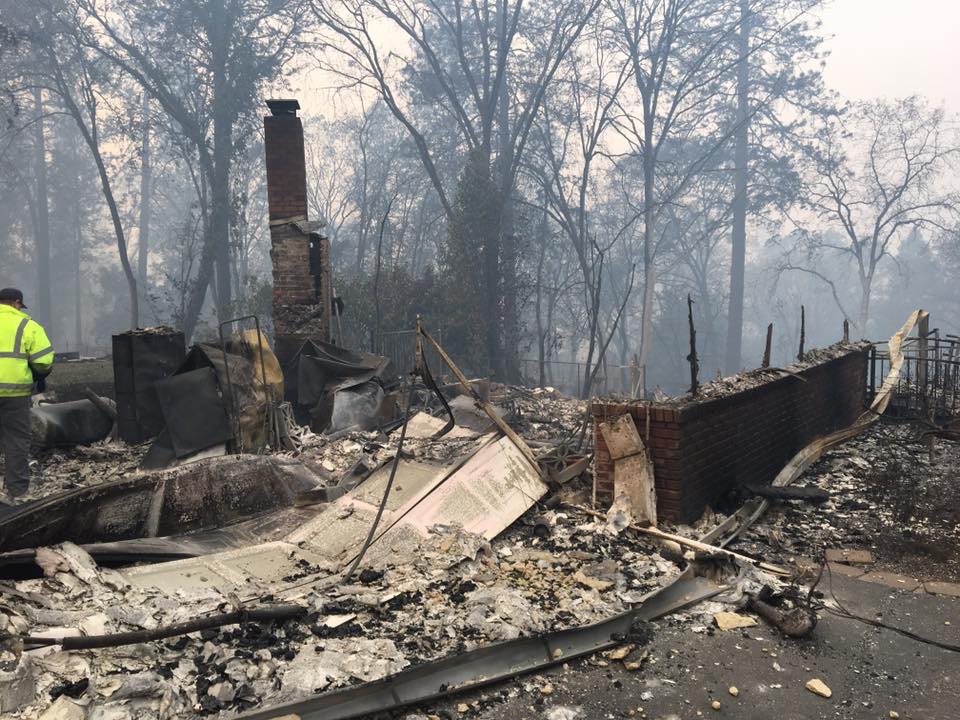
A poem I wrote the other night while grieving the loss of my hometown of Paradise:

I’m sorry – Please excuse the smoke.
It’s just the dreams and hopes of 27 thousand yesterdays.
It’s just the minuscule evidence of
That one baby picture,
That painting of the sea captain by my brother,
And those family portraits of the past 40 years.
It’s just the piano from my grandmother who passed away that my brother just brought back from Iowa.

Excuse the hazardous air quality.
It’s just the thousands of saved kid’s drawings and crafts, books, children’s toys from years gone by that had been unpacked for grandchildren, wedding certificates, diaries, the favorite pillows, that favorite teddy bear from baby years, the 1960s records and the VHS tapes of birthday parties and graduations.

It’s just the houses of my childhood friends where we would play in the late summer evenings and spend nights dreaming of what our grownup years would bring. Not knowing that our futures would all hold this moment in time as our collective yesterdays ascend to the sky.

Please excuse the falling ash.
It’s just the church where I grew up attending with all the children’s songs, VBS programs and the baptismal where I chose to dedicate my life to God. It’s just the aisle where I stood and looked at the man on the day that I said “I Do”.

The falling ash – It’s just Paradise.
A little non-destination town that’s not on the way to anything important. It’s just that end-of-the-road town where people settle and know each other and roots run deep. It’s just a place where the biggest news was that Taco Bell came to town 20 years ago – until Starbucks finally made it 4 months ago.

Paradise – it’s just the place where everyone is your neighbor, as backyards are shared and simple icons are known and loved. Icons that are now ashes falling around you (sorry about that).
Icons like Fosters Freeze.
Gold Nugget Days.
Honey Run Road Covered Bridge.
That one antique store, just to name a few.
Icons like Kalico Kitchen where my dad and I had breakfast on the day of my wedding, just the two of us.
Icons like Darlene’s Frozen Yogurt and Round Table Pizza where many birthday parties growing up took place, not to mention the take home pizzas to mom and dad on weekends we would visit.
Personal icons like the Lucas’s house where many days and nights were spent as we grew up from toddlers, to grade school, to junior high, taking care of animals, watching movies, going trick-r-treating, and discovering our first crushes together.
Icons like the Muth house, where we made brownies and talked about boys and got ready for banquets and wrote songs, and led out in different high school student leadership opportunities.
Icons like the youth room at the church where we discovered so many amazing things together and planned mission trips and prayer conferences and learned what it meant to be used by God right here and right now.
Icons like Rankin Way house where we would watch different phases of our family’s life every year as we gathered for potlucks, game nights or just hear some good music.
Or Country Club where huge gatherings would take place like the 4th of July party for the neighborhood, or just coming together for brunch, or talking about religion and politics.
Or Peterson’s house where we would eat the most delicious Swedish treats and have a visit from Santa.
Or all the houses around town that we lived in since age 2, (that are now all gone) and finally settling on what would become home: Boquest Blvd. Boquest, where breakfast was late, like nights, and eras of my life passed within those 4 walls – from preteen, to high school, and as the walls of my room changed their decor as they held my changing eras like a quiet, constant friend. The early mornings getting ready for school, the late nights studying or dreaming of tomorrows that are now todays. The Christmas eves and mornings where my brother would wake me up to go open our stockings. The night I spent in that room with my sister before the day of my wedding, our conversations waning into the early morning. The years and eras fleeting now in hindsight, as most recently these four walls had been a refuge for my aging parents. And not knowing that that one night would be my final farewell to my constant silent friend – my room – where I spent a few nights with my infant son as we cherished time with family. That last night, not knowing that we would be together for the last time…in Paradise.

… And not to mention all the lives that were lost: mothers and fathers, brothers and sisters, grandparents, beloved pets …


All of these things now ashes falling around you.

But please, once again, excuse our smoke.
It’s just what’s left of what was one of the most unique little settlements in the foothills of the Sierra Nevada Mountains: what was Paradise.💔

Copyright 2018 Krystalynn Martin, All Rights Reserved

I was sitting there today, in Whole Foods, eating my sandwich and watching the crowds.  I felt you move against my abdomen wall as my sandwich became food for you and me.  I’ve been sensing your wild nature from the beginning, even before I could feel you move.  I am aware of your warrior-ness, your tenacity, your fight for survival and to become life in this world we inhabit and call home.

And yet I worry.  As I touch my belly and feel your beautiful life form growing, I know the world that you as a female will enter into.  I am well-acquainted with the fingers that will try to choke out your individuality.  I cringe at the misogynistic world that awaits to devour your humanity and unique feminine war-like strength.  I shutter as I think of how religion will try to put its foot on your neck and gently scream of who you are as a woman and what you can and cannot be.  I abhor the thought of anyone who would turn you into a mere object to lust over, and what if you feel you must succumb to their eyes and wants, and you trade in your wildness to become the object rather than the creation.  I want to strip all magazine isles of the images that will shout out to you of what beauty is – so that you may find and discover the beauty that is already within you, and wear it fearlessly to the world.  I know the well-meaning voices that will advise you and scold you and insult you for simply being you.  I fear for the self-hatred that may try to creep into your soul, where you will try to bury your gifts and your beauty – that you would compare yourself with others and try to trade your uniqueness for theirs.  I already feel angry at the bully who may attempt to squelch your fight, your joy, your you-ness.

I haven’t met you, but I already know you are so much more than the shell of the body you will be born into.  Your body, which I know will be beautiful, is not what defines you.  As you are being knit inside me, your personality and character is there within you.  You are wild.  You are beautiful.  You are undefinable.  You are woman.  You are warrior.  You are more than fashion statements and mascara.  You are more than the boys who will chase you, or reject you.  You are beyond the opinions of mere people who will try to control you and morph you into their insecure status.  You are here for such a time as this.  Never let yourself be whittled down to a grade, or how many likes you get on Facebook. Never let yourself become consumed with your waist-size or if you’re wearing the right clothing brand. Instead, find your strength in the old oak trees.  Find your passion in the moving waters of river and sea.  Find your joy in soaking in the sun, playing with caterpillars, or laying in the grass barefoot, staring at the never-ending sky.  For you were created from beyond this substance we call our world.  You came from the unknown mystery of Love – a place that cannot be defined, or boxed, or placed in a cage.

So when others try to handcuff your soul, remember that it is impossible, unless you give them the keys to do it.  And why would you?  You are a warrior woman from beyond the farthest star in the universe!  You cannot be chained!  Yes, this world will test you to your very core.  Yes, magazine isles will scream lies of what beauty is.  Yes, misogyny will continue to exist, and there will be those who will try to objectify you.  Yes, religion will attempt to crush your talents and skills, especially if they see your wild-woman nature.  Yes, you will be tempted to contain your beauty only in hair, clothes and makeup.  Yes, you will feel your heart being ripped out of your chest as it is broken for the first time when you lose your first love.  But – you are still wild warrior woman!  You were wild warrior woman before these things existed, therefore these things cannot change what you already are!  You are undefinable.

judesys,moment,floating,ocean,sea,sunset-b1fcbfcf95c6b0abbf4b3d2e7ead02b8_h

So as I finished my sandwich, and stood to leave, I felt the eyes of those around me glance at my belly – at you.  Already you are doing it!  Your presence is already causing others to pause in the madness of their day.  Already you are reminding others of their true beauty and the miracle of being alive.

As I walk out of Whole Foods and carry you these next 7 weeks, and as your body completes the finishing touches of the rise and fall of legs, arms, toes, fingers, nose and ears.  As you finish becoming before you enter our world, I realize that every person I come in contact with is exactly what I have described you to be.  We are all undefinable.  We are all already beautiful.  We are in the presence of sacredness all the time when we are surrounded with other human beings.  Yeah, we all have the same sorts of body parts – arms, legs, heads, eyes, ears, mouths, etc.  But we are all completely undefinable in that there has and never will be anyone like you, like me.  Ever.  Ever!  So why do we hurt each other?  Why are there things like misogyny?  Why is there pornagraphy?  Why do we slaughter each other as if we’re replaceable?  Why do we use religion to cage the sacred, beautiful, warrior-like beings we are? Why do we let hate morph us into non-human creatures who will kill with our words, if not with our hands. When will it stop?  Perhaps when we believe that we are as sacred as we see our children to be.  Perhaps then we will realize that we are all, individually, sacred miraculous creations, sent from beyond the farthest star.  Perhaps when we see Love encapsulated within the flesh and blood walls of the population, a population that we are a part of.  Perhaps when we realize that we all hold the keys to stopping the misogynistic, lust-ridden, wounded, hate-absorbed, blood-drenched society we call our normal world.

So little one, thank you.  Thank you for reminding me of my wildness, of my nature that cannot be caged.  Thank you for opening my eyes to remember that all humanity is a beautiful, unique creation that should be cradled with utmost care.  Thank you for your jabs and kicks – a preview of the way you’re going to rock this world!  And may you know, that through all the highs and lows of what growing up will mean, with all the stereotypes screaming at you, that you are beautiful, mighty, strong and undefinable.  Because you are the only human being EVER to be you!  You are my warrior woman!

letter

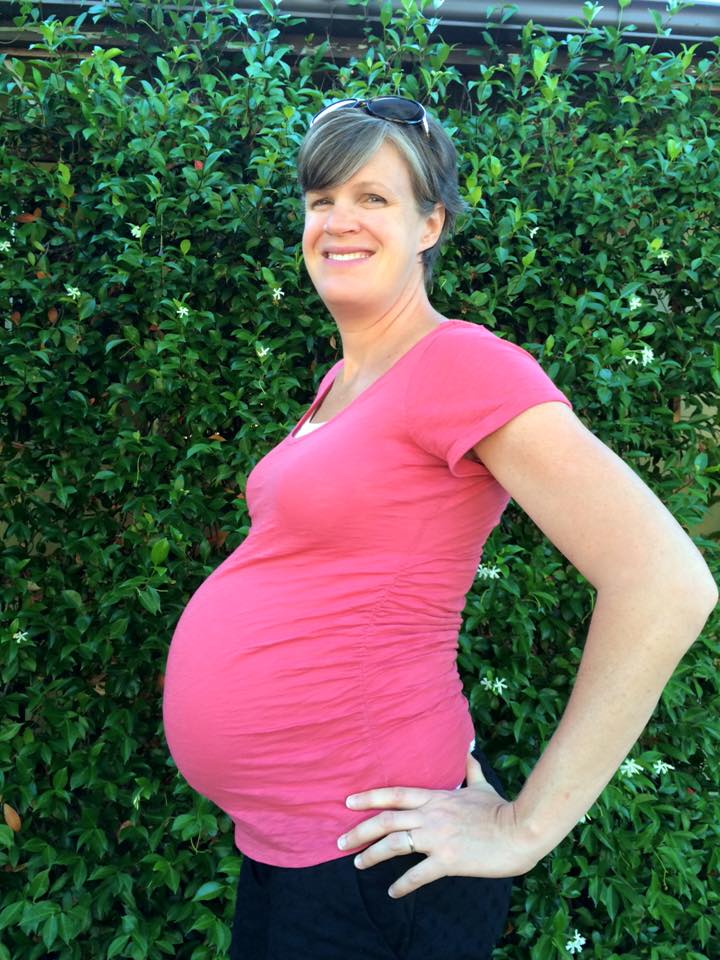
We didn’t expect to get pregnant.  My husband and I have been married for 12 years, and it hadn’t happened yet, so we just assumed it wouldn’t happen.  Then suddenly, walla!  I’m with child.  32 weeks along as I’m writing this.

My first reaction when I found out was “oh shoot!”  I know, not like the movies at all.  The first 12 weeks were a blur as I was away on Sabbatical getting my health back after experiencing chronic burnout.  We heard the heartbeat and “saw” her for the first time at 6 weeks. Pretty weird.

At 6 weeks

At 6 weeks

No, I didn’t cry – I was more stunned than anything.  At 12 weeks, we got another heartbeat and “saw” her again – this time instead of looking like a wormish creature from some bad sci-fi movie, she actually looked like a tiny human being with an alien head.  Wow.  That was fast.

At 12 Weeks

At 12 Weeks

Throughout the weeks and months that followed, we “watched” her grow and fight her way into existence, looking more and more human.  It’s been cool and weird to finally feel her movements, see her kicks and turning in my belly from the outside.  It’s been crazy to watch in helplessness as my abdomen balloons out to make room for this growing human being.  And I’m doing nothing to make it happen – except eating, exercising and trying to sleep.

At 18 weeks - Quite the Fighter!

At 18 weeks – Quite the Fighter!

Surrender.  That has been the beautiful thing throughout this process.  I’m not “in there” examining and micro-managing the process of her creation in my womb. I’m not leaving comments about how her toes need a different shape, or pressing a “like” button as I examine the process of growth.  It’s just happening. In fact, we have no clue what she will look like.  This is probably one of the longest things we as human beings living in western civilizations have to wait for.  We’re so used to taking an early peek, putting something on credit card so we can have it now, or over-nighting a product so we don’t have to wait.  But not with a human being.  9 months of waiting, wondering, fearing and hoping.  I’m not controlling a thing, and it’s still happening.  It’s pretty mind-blowing.

So I’m at week 32.  Haven’t “seen” her since week 18, but I know she’s there.  It’s fun to watch my belly move after I eat, as she dances (hopefully) from the delicious sustenance I’m providing her.  It’s cool to play music and feel a jab or kick, or perhaps it’s a twirl.  I can only imagine what it would be like to be a human in the womb.  Can you imagine?  The first time hearing something – ever!  Is it scary?  Is fear even realized yet?  And to start to see light coming through the pink lining of your world as your eyes open for the first time ever!  What is that like to experience as a human fetus?  Is there any wonder or joy at that stage?  Is there curiosity?  Do fetuses have bad days?  I actually looked up if babies cry in the womb before they’re born.  There’s substantial evidence that they do.  But what are they crying about? Do they have dreams yet?  Are they aware of danger, or surprises, or love?

All these thoughts have led me to other ponderings.  As they get used to their world, their routine, and their existence, do they imagine another world?  Can they fathom this world that they’re about to enter?  When birth happens, what the heck are they thinking?  Does it feel like they’re dying?  Are they disappointed to leave their comfort zone – forever?  In the resurrection of being born, can they fathom that this world is even possible?  As they take their first breath, does it hurt?  Is it scary to breath in air, and not amniotic fluid?  How does it feel to suddenly be flailing around, with no womb to push against?  Does it feel like they’re falling because of the expanse of space to move around in?  What’s it like to actually eat for the first time through the mouth?  Does it hurt to have the digestive system work for the first time with food-to-mouth?  What’s it feel like to experience touch on your skin for the first time as a newborn human?  And the brightness!  Can you imagine how the eyes must feel seeing the outside world?

At 31 Weeks

At 31 Weeks

So many thoughts and questions and wonderings!  Which makes me think of the Divine and the correlation between pregnancy, birth, and life on this planet and beyond.  Is this planet like our womb?  Do we think we know everything about it?  Do we feel scared when we experience something supernatural, like the fetus hearing noise for the first time but not knowing where it’s coming from?  If we haven’t “heard” God’s voice, does it mean He doesn’t exist, or maybe our spiritual hearing hasn’t developed yet.  Are there moments when it seems like we’re stuck and can’t breathe and maybe we’re ready for a birth into a new reality?  But are we afraid to leave our comfort zones, be it work, religion, etc?  Are there times that we feel out of control, when in reality perhaps we’re being born into a new experience that will bring us greater life, greater depth, greater love?  Just because some are not conscious of the Divine, does that mean the Divine does not exist?  Is my baby completely conscience of me?  Or is she happily living her life, doing whatever she does in that confined space all day, and not even thinking about me?  And yet, I’m in awe of her and her growth and movements.  Is the Divine even more in awe of us than a mother is for her growing child?  Is God mesmerized by our movements, our growth, our “becoming”?

As I hold my belly and feel the kick of this tiny human inside me, does she feel my hand cradling her punches and kicks?  Does she know she’s not alone?  As we think about where we are in our life and existence today, stop for a minute.  Have you sensed the Divine in some way?  Have you heard a faint voice?  Have you experienced some form of sustaining strength, comfort, wisdom or love that has fed your soul?  Have you felt the labor pains of change encouraging you to take that next step, even if it’s scary, because it might just be a breath of life that will expand your lungs and your horizons?  And if you haven’t sensed anything at all lately, could it be that you’re at some point in life where you are developing sight, sound and spiritual muscles that will soon open up worlds of wonder for you?

I still have a lot more expanding (literally) to do before this tiny human emerges upon the earth.  And then, as I’ve been told, the lesson of life will continue.  Lessons of surrender will deepen.  But ultimately, I find comfort knowing that the Divine carries me within this womb we call life, cradles me within the Almighty arms of ultimate Love, and sustains me whether I acknowledge the existence of a Higher power or not.  May we continue to live in awe of this life, and may we find hope that there is a possibility of another world to be born into.

pregnant-black-and-white

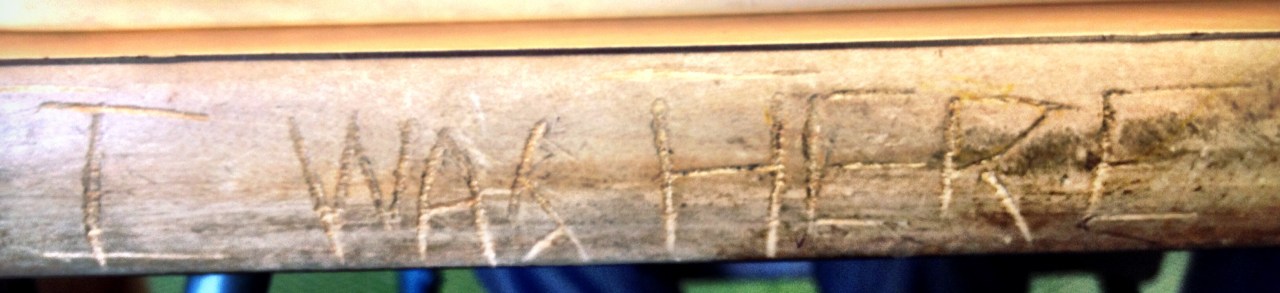
I noticed these words etched in a table at our school library recently.  Sitting mindlessly in a staff meeting, routines attached to me like puppet strings, pulling me in every direction.  And me, with no mind of my own, blindly following the prescribed script for the day.  I sat there, eyes glazed over, heart still pumping, but passion waning.  I appeared to be living, doing all my duties, following up on all my responsibilities, going through the motions.  Alive with a pulse, but asleep to awe and wonder.  In fact, perhaps just a warm body, with inconsistent pulse jumping now and then – walking like the dead – a zombie to the miracle of this moment.  Drenched in the monotony that had become my existence.  Apathetic moments filled with sighs and putting one foot in front of the other.  Moments filled with “making it through the day.”

I don’t even know what made me look.  I’ve sat at the same table on-and-off for 10 years.  10 years of staff meetings, of conversations, of announcements.  But today, it was as if these words whispered to my yearning soul.  My eyes drifted to the table’s edge.  Something went 0ff – an alarm of sorts.  It was if time stopped.  The sounds of the staff meeting suddenly faded into the background.  It was as if I was transported into a space and time where reality became clear.  It was as if I were in a sanctuary of awakening.

2014-02-04 12.52.49

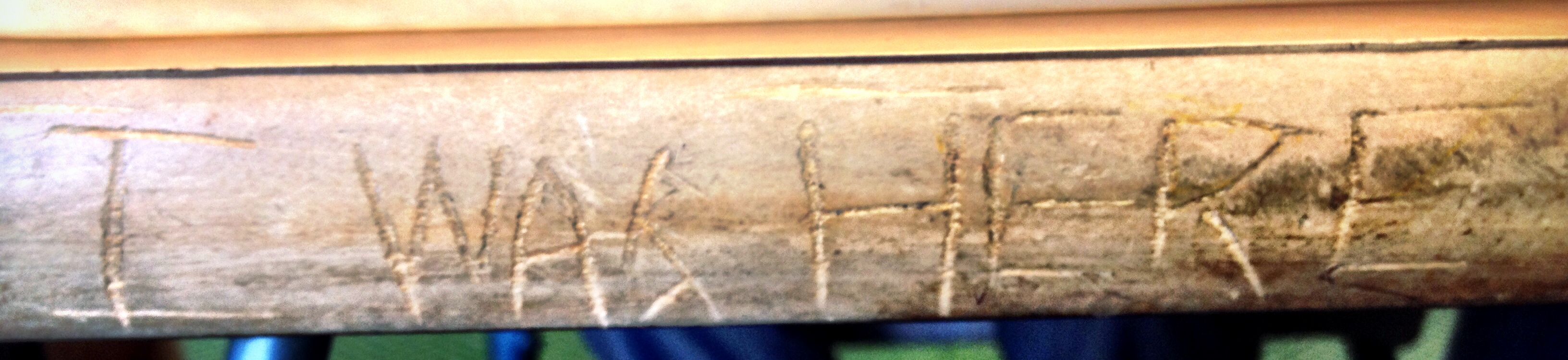
A snapshot of the words etched in that table

“I WAS HERE.”  Who wrote this phrase?  Who took the time to etch it into the side of the table?  Who was behind those words?  Like a standard thrust into the territory of their time and space, there it still stood.  Alone, bold, and courageous.  Proclaiming to whomever would notice or not notice, that “I” was Here!  A human cry from every heart to be seen, to be acknowledged, to be loved.  I WAS HERE.

Who was the face behind the “I”?  What was their story, their struggle, their journey?  Where were they now?  Had they found the acknowledgement they had hungered for?  Even as they etched that 3-word phrase, they had already bypassed that moment.  Why did they use past tense?  Why not proclaim in present tense words of “I AM HERE” ?

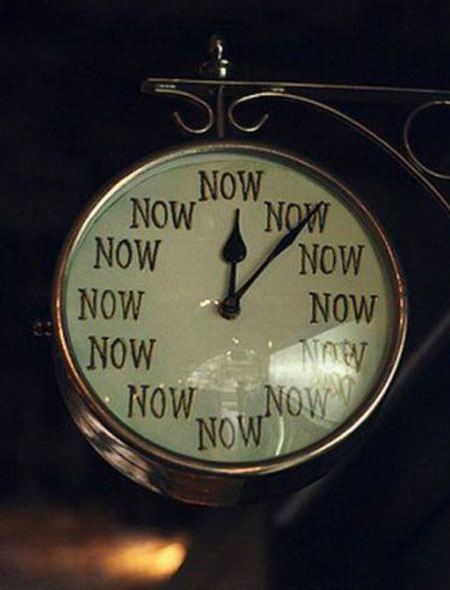
Then it hit me.  While conversations of calendar items and grades surrounded me, its truth slammed into my world.  With the whir of announcements and “life” happening around me – I WAS NOW HERE.  In the same place.  My fingers traced the outline of the words.  I saw them – I felt them.  I was now HERE.  This is now my time and space.  And even as I write this, “now” has just become “was”.  Time.  So fleeting!  Within milliseconds HERE becomes THERE, and NOW becomes THEN.  IS becomes WAS, and TODAY becomes YESTERDAY.  In fact, could it be that right now we are making history and creating the masterpieces that will guide and inspire the human race of tomorrow?  We are all leaving our etch into this world – “I WAS HERE.”

Time:  so present.  Why aren’t we? In the madness of bills to pay, mouths to feed, calendars to fill, obligations to meet, responsibilities to carry out, are we aware of NOW?  I AM HERE.  YOU ARE HERE.  Like a mark on a map at the mall, or an appointment written down on a calendar space, or a carved phrase etched into wood, we are HERE – right here.  Why do we live life as if we’re on some moving escalator, helpless to the turns, events, choices…always yearning for the weekend, or the next vacation, or the end of the day.  Waiting and counting down the NOW moments til the next TV show, the next meal, the next appointment, our next Facebook post, the next move.  Surrounded in the midst of creating the photo album of our life, we are so many times already in past tense mode, planning our next agenda item, our next encounter, our next moment worth savoring.  Not realizing that perhaps we are in the middle of making a memory that we’ll yearn for later on.  Ironically, in the moments we rush past, we make ourselves extinct.  For if we are constantly ever-living in the future or the past, and we are never in the now, then we are really not alive.  Because life exists right now.  The past can’t be changed.  The future hasn’t happened yet.  Life only happens Right NOW!

The-Time-Is-Now

I still wonder who carved that phrase in that table.  I hope they’re living a beautiful life where they are fully aware of the miracle of this moment.  As the staff meeting came to an end, with the rest of that day waiting with bated breath to be realized, I walked out with a warmer heart, a revived sense of being, and a returned pulse to the wonders surrounding me.  I wish I could meet this person who left their mark on that table, and thank them for the prophetic reminder.  That their words have been whispering to me, “don’t settle; open your eyes; you only have so much time in this moment!”  I’ve been reminded that happiness is actually present in THIS moment, as close and as subtle as faded words etched in a table.  The choice is ours whether or not to slow down and be present to that miracle.  Because, regardless of whether or not we’re aware of it, WE ARE HERE.

I’ve heard a few people say “he should have stayed home.” Here’s the thing: real injustice has never ended because people stayed quiet. It ends because ordinary people refuse to look away.

Imagine if we said the same thing about Martin Luther King Jr? He should have stayed home and not broken the law. Rosa Parks should have just sat at the back of the bus. The Selma March for voting rights should have just turned away at the bridge when they saw the police, billy clubs and tear gas.

In the 1963 Birmingham children’s march, those kids should have stayed home and not get sprayed with fire hoses and chased by dogs and locked up in jail. Martin should have kept quiet about his dream. There should have been no march on Washington. No sit-ins. No bus boycott. No Black Lives Matter. Why are there always those who cause so much trouble? Good trouble…necessary trouble? Shhhhh… go home.

If all would have stayed home there would be no civil rights act, no voting rights act, no Letter from a Birmingham Jail, no witness to the Japanese internment camps, no change to unjust laws, and one could go on and on. In fact, in Jesus’ parable of the Good Samaritan, the one who was righteous didn’t head home but rather took care of the wounded.

What’s happening right now is not just ICE executing warrants on violent criminals. There is well-documented evidence of people being detained without criminal convictions, sometimes without warrants presented, including law-abiding residents, asylum seekers, and people with legal status. In fact, many U.S. citizens have been held for days without beibg allowed to see a lawyer or make a phone call. That’s why civil rights organizations, faith leaders, medical professionals, and even some state officials are speaking out.

“Just stay home and trust the system” has always protected the powerful, not the vulnerable.

Standing up against injustice doesn’t mean supporting violence. It means saying:
 • Due process matters
 • Human dignity matters
 • Government power must have limits

People protest not because they hate law enforcement, but because unchecked authority is dangerous, especially when it targets marginalized communities. Silence has never been neutral — it has always chosen a side. And to protest is the 1st Amendment right of every citizen.

Also, fun fact, Pretti didn’t show up to a protest. He was in his community, saw a woman being attacked by “law enforcement” and came to her aide. He embodied the greatest sacrifice – loving others greater than oneself. He embodied what Jesus spoke of.

Copyright 2026

In December of 2022, I completed my Master’s Degree in Transformative Social Change, with an emphasis on Peace and Justice. The following is the literature review from my master’s project that I feel covers so much information that “the church” misses when it comes to conversations around defining white supremacy, racism, and reparations. The first segment defines what “white supremacy” is, and the second segment goes deeper into what the Christian response should be in relation to addressing the impacts of white supremacy, how to fight against racism, and what reparations look like. My hope in sharing this is to provide resources and normalize conversations that followers of Christ should be at the forefront in. When I use the term “Christian”, I am referring to people who have chosen to live a life of justice, mercy, and love for mankind.  This is the start of more conversations.

What is White Supremacy

Sociologist and scholar Andrea Gibbons (2018) defines white supremacy as a system that is not only global, but is systemic in its economics, culture, politics, and is instrumental in the fabric of how many organizations were created and how they operate. Francis Lee Ansley (1989) states:

By “white supremacy” I do not mean to allude only to the self-conscious racism of white supremacist hate groups. I refer instead to a political, economic and cultural system in which whites overwhelmingly control power and material resources, conscious and unconscious ideas of white superiority and entitlement are widespread, and relations of white dominance and non-white subordination are daily reenacted across a broad array of institutions and social settings” (1024).

As renowned author Layla F. Saad (2020) writes, “White supremacy is far from fringe…it is the dominant paradigm that forms the foundations from which norms, rules, and law are created” (p. 13). White supremacy is systemic in nature and utilizes other created systems and ideologies to maintain its power (Davis et al., 2021).

Author Isabel Wilkerson (2020) makes the argument that white supremacy was and is the creation of a sort of “caste” system and utilizes race within that system: “Race, in the United States, is the visible agent of the unseen force of caste. Caste is the bones, race is the skin. Race is what we can see, the physical traits that have been given arbitrary meaning and become the shorthand for who a person is. Caste is the powerful infrastructure that holds each group in its place” (Wilkerson, p. 19).

White supremacy is not referring to the physical color of someone’s skin (Saad, 2020), but rather to “the historic and modern legislating, societal conditioning, and systemic institutionalizing of the construction of whiteness as inherently superior to people of other races” (Saad, p. 13).

The term race is not based on biology (Gibbons, 2018; Wilkerson, 2020), but rather was and is an ideology created and maintained for the purpose of control and dominance over land, resources and people groups (Gibbons, 2018; Taylor, 2016; Wilkerson, 2020). White supremacy partnered with systemic racism is all “about power and its abuse” (Davis, et al.,2021 p. 359). Activist and scholar Keeanga-Yamahtta Taylor (2016) notes that “racism, capitalism, and class rule have always been tangled together in such a way that it is impossible to imagine one without the other” (Taylor, p. 216).

  White supremacy shows up in everyday social settings, in what is called “white space,” which is defined by scholars as “the normative operation of race and racism in geographical, physical, ideological, and cultural space” (Embrick & Moore, 2020, para. 5). Educational researcher David Gillborn (2006) points out that white supremacy is “seen to relate to the operation of forces that saturate the everyday, mundane actions and policies that shape the world in the interests of white people” (Gillborn, p. 320).  This is why advocating for and strategizing for Black, Indigenous, People of Color (BIPOC) in places of leadership within organizations is so important (Carruthers, 2018). However, it is also important when advocating for BIPOC individuals to represent in different roles within organizations to not do so purely for the sake of tokenism (Gooding & Mehrotra, 2021).

Philosopher Charles Mills (2021) points out how in recent years, more white people are becoming awakened to the distinction of how white supremacy not only affects them as individuals, but also is a structure that they must play a part in dismantling:

Especially in the aftermath of George Floyd’s killing…by the Minneapolis police, and the massive demonstrations of last summer, there is now far greater self-consciousness in the white American population about this issue. So that’s a welcome development, obviously. The danger is that many whites may think that their moral responsibility has been fulfilled by performing some minor discrete act, when in fact structural white domination can only be dismantled by a collective national effort for which organized white participation will be crucial” (p. 166).

The process of dismantling systems of white supremacy is possible, although it will require ongoing research, strategy, critical thought, dialogue, and activism (Adams, 2020; Davis et. al., 2021; Gibbons, 2018; Mills, 2021; Resane, 2021; Saad, 2020). 

Theologian Kelebogile Resane (2021) explains one important early tactic in dismantling white supremacy is the power of dialogue among members representing different cultural backgrounds, stating that “avoiding dialogue on race contributes to racism” (Resane, p. 8).  The power of dialogue among different experiences and perspectives is one of the keys in addressing the problem of racism (Resane, 2021). When dialogue doesn’t take place, ignorance continues to keep white supremacy maintaining its power (Gibbons, 2018). Although dialogue around racism can “include the outward display of emotions such as anger, fear and guilt, and behaviors such as argumentation, silence and leaving the stress inducing situation” (Resane, 2021, p. 2), this dialogue ultimately generates hope, as it is a necessary step for change to take place, especially when partnered with research, strategy, and activism (Adams, 2020; Davis et. al, 2021; Gibbons, 2018; Mills, 2021; Resane, 2021; Saad, 2020). In fact, some organizations are finding that dismantling institutional systemic racism is possible, especially when there is focused, collaborative effort with consultants who help that organization facilitate systemic change (Patel, 2022). White supremacy is very much a part of the fabric of our society, but it is possible to be a part of the work in dismantling its power.

Christianity, Racism, and the Case for Reparations

             In 1998, Christian leader and author Patrick Glynn (1998) wrote that “religious groups may offer the best hope for improving race relations in this country” (Glynn, p. 834), yet we still seem to not have realized that “hope” 22 years later. In fact, some scholars found that those who are a part of different traditional religious groups seemed to be tied to racist ideologies and found that “only religious agnostics were racially tolerant” (Hall et. al., 2010, p. 126). A particular case study reveals that without specific and strategic plans in place, Christian churches and communities will not actively address the impacts of white supremacy, even if they have the intention to do so (Okokara, 2021). However, this paradigm is starting to shift as Christians are realizing that they are not immune to racism since racism and white supremacy are a part of society and Christians live within that society (Brown, 2019).

Religious scholar Judith Gruber (2021) suggests that some Christians will, under the guise of being “innocent” (p. 518) from the history of past racism, not be able to see themselves as being a part of the system of white supremacy and will therefore not see a need to right the wrongs of the past, particularly the sin of racism. Gruber and other religious leaders and scholars suggest that a Christian should remember that once they are saved from sin, they should no longer live in it, including the sin of racism (Fleischhauer, 2020; Gruber, 2021; Harvey, 2020). As theological scholar Kelebogile Resane (2021) notes, “racism is a sin against God and humanity” (p. 8). Many Christians are taking up the task of understanding racism in the church and are learning ways of addressing the effects of racism within their communities (Brown, 2019).

            It is important here to unpack one of the foundational beliefs of Christianity. To be a member of a Christian community, also known as a Christ-follower, one is expected to adhere to the teachings of Jesus and follow Biblical principles in how one conducts their life. One of these important tenants is based on Jesus’ teaching about loving others and living a life that alleviates the suffering and injustice that impacts humanity (Harvey, 2020; Keller, 2012; Resane, 2021). A famous passage from the Bible (New American Standard Version, 1995/1960) describes how a Christian should live when it says, “…And what does the LORD require of you but to do justice, to love kindness, and to walk humbly with your God” (Micah 6:8).

It is important to understand the original Biblical definition of this kind of justice. The Hebrew words for justice are mishpat and tzedakah. The definition of mishpat centers around the concept of rectifying or repairing past and current wrongs, whereas tzedakah can be defined as living a life of right relationship with others. Author, apologist, and pastor, Timothy Keller (2012) unpacks these Hebrew definitions in light of the importance of social justice to the Christian:

“These two words roughly correspond to what some have called “primary” and “rectifying justice.” Rectifying justice is mishpat. It means punishing wrongdoers and caring for the victims of unjust treatment. Primary justice, or tzedakah, is behavior that, if it was prevalent in the world, would render rectifying justice unnecessary, because everyone would be living in right relationship to everyone else. Therefore, though tzedakah is primarily about being in a right relationship with God, the righteous life that results is profoundly social…When these two words, tzedakah and mishpat, are tied together, as they are over three dozen times, the English expression that best conveys the meaning is “social justice” (paras. 15 and 18).

Renowned Jewish scholar, Rabbi Jonathan Sacks (n.d) expounds further on the Hebrew definition of tzedakah when he explains that although it can be translated in different ways such as justice, equity, and fairness, the definition of tzedek/tzedakah is understood to mean: “Justice plus compassion equals tzedek, the first precondition of a decent society” (para. 20).

If members of a Christian community are to become invested in living out the meaning of these definitions of Biblical social justice, it will mean practicing mishpat (rectifying or repairing past and current wrongs) to live a life of tzedakah (living a life of right relationship with others).

Theologian and religion professor Jennifer Harvey (2020) makes a strong case for reparations that correlates with these definitions of mishpat and tzedakah. Reconciliation, which many believe to be an attribute of the Christian life, can never take place if systems of oppression do not change, and we cannot ask for racial reconciliation when we have not first done the work of reparations (Harvey, 2020).

If a Christian community who have caused harm fail to rectify or repair that harm (mishpat), it will be close to impossible to move forward in healing, reconciliation, and living a life of right relationships (tzedakah) (Brown, 2019: Harvey, 2020; Keller, 2012; Resane, 2021). Harvey makes the argument that for a true follower of Christ to actually seek reconciliation, it would require first to go through the journey of reparations, otherwise the goal for reconciliation can be seen as a quick fix only on the part of the white Christian, and can actually keep the systems of injustice and white supremacy in place, thus continuing the harm against people of color whom white Christians are stating they are trying to reconcile with (Harvey, 2020). In fact, Harvey unpacks the history of the Civil Rights era of the 1960’s, revealing that many white Christians were pushing for racial reconciliation. However, when Black Christians asked white Christians for reparations before reconciliation could take place, most white Christians retreated from the conversation (Brown, 2019; Harvey, 2020). 

Considering the concepts of reconciliation and reparations, Christian theologian Douglas Foster (2020) makes a strong argument of why reconciliation can’t happen until reparations take place when he writes,

there has never been “conciliation”-a relationship of unity and harmony between whites and persons of color-in the history of America. To assume ignorantly that racial reconciliation is a search to restore a mythical harmony that once existed is to distort and cover up the truth. The truth is that white Americans, driven by the ideology of white supremacy, created and perpetuated the systems of injustice, caused the racial division, and spread the disease that has infected the nation since its beginning-and most claimed to be followers of Christ” (p. 66).

Religious scholar Michelle Oyakawa (2019) points to research revealing that racial reconciliation apart from reparations actually causes harm and reinforces “white social and cultural dominance” (p. 499) and “calls for racial issues to be suppressed in favor of unity” (p. 502). Reparations, therefore, must first take place if any kind of reconciliation is to be a reality.

Reparations in this context is about changing systems of white supremacy that are still very much at work in this country and world (Harvey, 2020). Christian ethics scholar Michael Banner (2022) makes a strong argument for reparations when he states that those who have been a part of or have benefitted from systems of oppression must do more than just acknowledge the truth of that oppression. That acknowledgement of wrongs committed must be followed by actions to repair the harm done: “it is the saying and the doing which together are essential to facilitating moral repair” (Banner, para. 28). This type of reparations should become the relevant battle cry of invested Christians who want to live out the Biblical social justice of mishpat and tzedakah in their everyday lives and communities as they address the impacts of white supremacy where they live (Harvey, 2020; Keller, 2012). Harvey unpacks how to embark on this type of reparations when she writes: “…the question of how is quite simple: we are the ones who have to figure that out, create and build reparations, responses and processes. Yes, there are theories and models that those engaged in reparations activism have proposed and built. Yes, we can and should engage these to grow our understanding and point our imaginations in the right direction in terms of the possibilities” (Harvey, p. 243).

When comparing the definitions of white supremacy with the need for reparations, it is evident that the system of white supremacy to the Christian is a system of injustice that goes against the Biblical mandates of justice (both mishpat and tzedakah) and are contrary to the requirements of how God commands His followers treat others and how to conduct life (Harvey, 2020; Keller, 2012; New American Standard Version, 1995/1960; Resane, 2021). It is therefore the Christian duty to not only denounce the systemic injustice of white supremacy, but to also live out the principles of justice by starting and continuing the work of reparations within any system we find ourselves residing or working in, including the church. (Banner, 2022; Brown, 2019; Gruber, 2021; Harvey, 2020; Resane, 2021).

REFERENCES

Adams, W. J. (2020). A Rhetoric of Resentment: Dismantling White Supremacy through Definition, Scholarship, and Action. [Dissertation].

Ansley. (1989). Stirring the ashes: race, class and the future of civil rights scholarship. Cornell Law Review, 74(6), 993–.

Ares, N., Evans, D. M., & Harnischfeger, A. M. (2018). Systemic constraints on students’ appropriation of reform oriented curriculum. Critical Questions in Education, 9(1), 1-21.

Banner, M. (2022). Telling Lies, Telling Tales and Telling (and Doing) the Truth: Racism, Moral Repair and the Case for Reparations. Studies in Christian Ethics; Studies in Christian Ethics, 35(1), 41-62. https://doi.org/10.1177/09539468211051197

Bobo, K., Kendall, J., & Max, S. (2010). Organizing for social change: Midwest Academy manual for activists. Santa Ana, CA: The Forum Press.

Brown, A. W. (2019). Racism and the Christian Church in America: Caught between the Knowledge of Good and Evil. Social Work in Public Health; Soc Work Public Health, 34(1), 134-144.  https://doi.org/10.1080/19371918.2019.1566111

Brown, M. B. (2017). Emergent strategy: Shaping change, changing worlds. Chico, CA: AP Press.

Buehler, J. (2013). ‘There’s a problem, and we’ve got to face it’: how staff members wrestled with race in an urban high school. Race, Ethnicity and Education, 16(5), 629-652. https://doi.org/10.1080/13613324.2011.646256

Carruthers,C. (2018). Unapologetic: A Black, queer and feminist mandate for radical movements. Boston, MA: Beacon Press.

Castagno, A. E. (2008). “I don’t want to hear that!” Legitimating whiteness through silencing in schools. Anthropology and Education Quarterly, 39(3), 314-333.  https://doi.org/10.1111/j.1548-1492.2008.00024.x

Corbitt, A. (2019). Revising resistance: A step toward student-centered activism. Voices from the Middle, 27(2), 28.

Davis, J. P., Cramer, E. L., Streater, R. L., & Suter, M. R. (2021). Antitrust as Antiracism: Antitrust as a Partial Cure for Systemic Racism (and Other Systemic “Isms”). Antitrust Bulletin, 66(3), 359-383. https://doi.org/10.1177/0003603X211023620

Dumas, M. J. (2014). “Losing an arm”: Schooling as a site of black suffering. Race Ethnicity and Education, 17(1), 1-29. https://doi.org/10.1080/13613324.2013.850412

Embrick, D. G., & Moore, W. L. (2020). White Space(s) and the Reproduction of White Supremacy. The American Behavioral Scientist (Beverly Hills), 64(14), 1935-1945. https://doi.org/10.1177/0002764220975053

Foster, D. A. (2020). Reclaiming Reconciliation: The Corruption of “Racial Reconciliation” and How It Might Be Reclaimed for Racial Justice and Unity. Journal of Ecumenical Studies, 55(1), 63-81.  doi:10.1353/ecu.2020.0015.

Fleischhauer, J. (2020). Schuldig durch Geburt. Wer weiß ist, kann nur Rassist sein. Focus.

Galloway, M. K., Callin, P., Shay, J., Vimegnon, H., & McCall, L. (2019). Culturally responsive, antiracist, or anti-oppressive? How language matters for school change efforts. Equity & Excellence in Education, 52(4), 485-501. https://doi.org/10.1080/10665684.2019.1691959

Gibbons, A. (2018b). The Five Refusals of White Supremacy. The American Journal of Economics and Sociology, 77(3-4), 729-755.  https://doi.org/10.1111/ajes.12231

Gillborn, D. (2006). Rethinking white supremacy: Who counts in ‘WhiteWorld’. Ethnicities, 6(3), 318-340. https://doi.org/10.1177/1468796806068323

Gooding, A., & Mehrotra, G. R. (2021). Interrupting White Supremacy in Field Education: Experiences of Microaggressions in Placement Settings. Advances in Social Work, 21(2), 311-330. https://doi.org/10.18060/24095

Gruber, J. (2021). White Innocence / White Supremacy: Exploring the Theo-political Intersections of Race and Salvation. Interdisciplinary Journal for Religion and Transformation in Contemporary Society, 7(2), 515-538. https://doi.org/10.30965/23642807-bja10022

Glynn, P. (1998). Racial reconciliation: Can religion work where politics has failed? American Behavioral Scientist, 41(6), 834-841. https://doi.org/10.1177/0002764298041006005

Grinage, J. (2019). Endless mourning: Racial melancholia, black grief, and the transformative possibilities for racial justice in education. Harvard Educational Review, 89(2), 227-250,329.

Hall, D. L., Matz, D. C., & Wood, W. (2010). Why Don’t We Practice What We Preach? A Meta-Analytic Review of Religious Racism. Personality and Social Psychology Review; Pers Soc Psychol Rev, 14(1), 126-139. https://doi.org/10.1177/1088868309352179

Harper, S. R. (2013). Am I my brother’s teacher? Black undergraduates, racial socialization, and peer pedagogies in predominantly white postsecondary contexts. Review of Research in Education, 37(1), 183–211.

Harvey, J. (2020). Dear white christians: For those still longing for racial reconciliation. Grand Rapids, MI. William B. Eerdmans Publishing Company.

Hawkins, G. L. (2018). White environments, black students: A case study of dominant white realities in higher education [Dissertation]. Azusa Pacific University

Hood, O. D., Jr. (2012). Differentiated instruction in developmental mathematics classes and achievement of ethnic minority students [Dissertation]. Capella University.

Howard, J. (2018). That’s not something we have to discuss: Interrupting silences about multiracial students in teacher work. The Urban Review, 50(4), 693-712. https://doi.org/10.1007/s11256-018-0462-0

Keller, T. (2012, August). What is biblical justice? Relevant magazine. https://relevantmagazine.com/faith/what-biblical-justice/

Linley, J. L. (2018). Racism here, racism there, racism everywhere: The racial realities of minoritized peer socialization agents at a historically white institution. Journal of College Student Development, 59(1), 21-36. https://doi.org/10.1353/csd.2018.0002

Lofton, R., & Davis, J. E. (2015). Toward a black habitus: African Americans navigating systemic inequalities within home, school, and community. Journal of Negro Education, 84(3), 214-230.

Mills, Charles. (1997). The Racial Contract. Ithaca, NY: Cornell University Press.

Mills, C. W., & Srdjan, V. (2021). Race, liberalism, and global justice: Interview with charles W. mills. International Politics Reviews, 9(1), 155-170. doi:https://doi.org/10.1057/s41312-021-00085-2

Nance, J. P. (2017). Student surveillance, racial inequalities, and implicit racial bias. Emory Law Journal, 66(4), 765-837.

New American Standard Bible (1995). Lockman Foundation. (Original work published 1960)

Odokara, C. (2021). Racial and Ethnic Diversity and Inclusion in Selected U.S. Christian Denominations: A Multiple Organizational Case Study (Ph.D.). [Dissertation]

Oyakawa, M. (2019). Racial Reconciliation as a Suppressive Frame in Evangelical Multiracial Churches. Sociology of Religion, 80(4), 496-517. https://doi.org/10.1093/socrel/srz003

Patel, N. (2022). Dismantling the scaffolding of institutional racism and institutionalising anti‐racism. Journal of Family Therapy, 44(1), 91-108. https://doi.org/10.1111/1467-6427.12367

Pollock, M. (2004). Colormute: Race talk dilemmas in an American school. Princeton University Press.

Posey-Maddox, L., de Royston, M. M., Holman, A. R., Rall, R. M., & Johnson, R. A. (2021). No Choice Is the “Right” Choice: Black Parents’ Educational Decision-Making in Their Searchfor a “Good” School. Harvard Educational Review, 91(1), 38-152.

Powell, J. & Menendian, S. (Summer, 2016). The Problem of Othering: Towards Inclusiveness and Belonging. Othering & Belonging. https://www.otheringandbelonging.org/the-problem-of-othering/?fbclid=IwAR3qW6tRlFWXaQEmMJXPtmsT6zDCL6xQKBfqGCC_44hNrY0s9gr1ieeCHro

Resane, K. T. (2021a). White fragility, white supremacy and white normativity make theological dialogue on race difficult. In Die Skriflig : Tydskrif Van Die Gereformeerde Teologiese Vereniging; in Skriflig (Online), 55(1), 1-10.  https://doi.org/10.4102/ids.v55i1.2661

Saad, L. F. (2020). Me and white supremacy Combat racism, change the world, and become a good ancestor. Naperville, Ill: Sourcebooks.

Sacks, Rabbi Jonathan (n.d.). Tzedek: Justice and compassion. Covenant conversations. https://www.rabbisacks.org/covenant-conversation/devarim/tzedek-justice-and-compassion/

Scott, J., Moses, M. S., Finnigan, K. S., Trujillo, T., Jackson, D. D., & University of Colorado at Boulder, National Education Policy Center. (2017). Law and order in school and society: How discipline and policing policies harm students of color, and what we can do about it. National Education Policy Center. https://nepc.colorado.edu/sites/default/files/publications/PB%20Law%20and%20Order_0.pdf

Schirch, L. (2013). Conflict Assessment and Peacebuilding Planning: Toward a Participatory Approach to Human Security. Lynne Rienner Publishers.

Singleton, G. (2018). Beyond random acts of equity: Courageous conversation about transforming systemic culture. Learning Professional, 39(5), 28-33. 

Smucker, J.M. (2017). Hegemony how-to: A roadmap for radicals. Chico, CA: AK Press.

Taylor, K. (2016). From #BlackLivesMatter to Black liberation. Chicago, Ill: Haymarket Books.

Temkin, D., Harper, K., Stratford, B., Sacks, V., Rodriguez, Y., & Bartlett, J. D. (2020). Moving policy toward a whole school, whole community, whole child approach to support children who have experienced trauma. The Journal of School Health, 90(12), 940-947. https://doi.org/10.1111/josh.12957

Thomas, D. J., Johnson, M. W., Clark, L., & Harrison, L. (2020). When the Mirage Fades: Black Boys Encountering Antiblackness in a Predominantly White Catholic High School. Race, Ethnicity and Education, ahead-of-print(-), 1-20. https://doi.org/10.1080/13613324.2020.1798390

Wilkerson, I. (2020). Caste: The origins of our discontents. New York: Random House.

“I don’t know what it’s like, so I can’t speak…”

“What if I’m misunderstood?”

“I don’t want to seem too political…”

“What can I do?  What can I say?”

“I don’t want to sound patronizing or condescending…”

And the list could go on and on and on.  This is what the perceived paralysis of white privilege looks like.  Let me break this down.

Now, I know that “white privilege” can trigger many responses in some people.  People may say, “I don’t see color,” or “why do you have to make it a racism thing?”  or “I’m not racist.  We’re all human…”  Which may be how you truly feel, but the very fact that there is a choice in whether or not to CHOOSE to say something, proves that there is a privilege.  So if you’re feeling offended by the term “white privilege”, just keep listening with an open mind and maybe see it through a new lens.

Let’s analyze this term privilege. Privilege is “a special right, advantage, or immunity granted or available only to a particular person or group of people.” (Oxford Dictionary) Privilege is proven when we can sit from our couches and criticize cities being destroyed by “those people.”  Privilege is proven when I don’t understand why people are “rioting” and “destroying property”, but I didn’t say anything about the unjust violence that led to the protests, cuz it was too political. Privilege is proven when the conversation is uncomfortable and I can leave, and it stays where I left it.  Privilege is proven when I feel I may receive backlash for saying something or doing something, and I choose not to so that I can protect myself or my family, my job, my title, etc.  Basically, to have privilege means that someone has freedom to choose or not choose certain actions, and there will be little or no repercussions to those choices.

And this brings up the whole Black Lives Matter debate. Stay with me, as this can also be a triggering phrase.  But take your emotions out of it for a minute, and put on your learning lens. So what’s the Black Lives Matter debate again?  In a nutshell, privileged people who aren’t aware of their privilege will say “All Lives Matter”.  This statement is very true; however it is not being lived out in reality, as we see people of different races being treated unjustly, and even murdered.  Therefore, “Black Lives Matter” is a call for justice, a call for the reality of “All Lives Matter”, not just in concept, but in practice.  If “All Lives Matter” was a true reality, we wouldn’t need to say “Black Lives Matter.”

I want to share a personal experience I’ve had with someone using their privilege to benefit me. I don’t know firsthand what it is to be discriminated against based on the color of my skin.  But I do know what gender discrimination feels like.  As a female pastor, I have been called names by church people that are definitely not PG-rated.  I have been told I’m going to hell.  I have been told that God doesn’t approve of me because of being a female pastor. I have been physically accosted at events for being a female pastor. I’ve been personally attacked on social media and even people who have worked at the highest levels of the church have personally attacked me to my face.  At times, I would wonder when my brothers in ministry would rise up and have my back?  Why would I ask about them?  Because they had the respect of the men (and even sometimes women) who would only hear them because they were a man. They had the privilege of being male to that specific audience. If I spoke up to defend myself, which I have and still do, I would many times be seen as an angry feminist or a liberal, or … you fill in the blank.  I couldn’t defend my validity to some because they already saw me as flawed and wouldn’t hear my voice.  But they would hear a man’s voice.

Then something amazing happened.  About 10 years ago it really surfaced.  Men started speaking up for female pastors.  And not just any men, but fellow pastors, conference workers, and men who had titles and positions that they could lose if they spoke up.  Some men turned in their ordination credentials and asked for commissioning credentials (what many women are only endorsed with) in a move of solidarity.  Once when I was attacked by a male pastor, I had other male pastors who came to my defense.  They used their privilege of being male to not just defend me, but to support me.  There would be times we would even hear men say “now I’m not a female and I don’t pretend to know what you’re going through, but I stand with you and this is wrong!  I will raise my voice with yours.”  That was privilege being used.  And it felt amazing.  It felt like suddenly we weren’t alone in this fight.  It gave me energy to keep fighting for what I knew was right, to keep using my God-given gifts to change the world, and to keep moving forward, even amongst the critical, misogynistic and sexist voices. We felt empowered as we now had others, others who had the ear of those who were mistreating us, who JOINED us in the fight.  We weren’t alone.  They used their privilege to do what was right.  They saw us as sisters and fellow colleagues.  We weren’t offended by their privilege:  we were encouraged by it.

Now I imagine, and at times we even heard it, the men would say “now I’m not a female, so I can’t help you…” or “what if I’m misunderstood…” or, quietly and privately “this thing is so crazy that is happening!  We got your back” but then when it came down to it, didn’t follow through. Or “I wish I could do more but it’s bad optics…” Or even worse, the silence.  Not knowing where someone stood.  The silence was louder at times than the critics. So, I use this personal illustration as a way of making a comparison.  To use our “white privileged” voice is actually a compliment.  It’s a secret weapon against discrimination, bigotry, fear, racism, hatred, etc.  To use white privilege is not condescending:  it’s empowering.  It’s voicing and reminding the FACT that we are ALL children of God and so why be afraid to voice it?  It’s a powerful way to encourage our fellow sisters and brothers.  To stay silent makes our privilege evident, and I would say is worse than the racist actions and comments of others.  Why?  Because we hold the key to helping stop the hatred, so our silence is complicit.

There is this perceived paralysis of white privilege, but remember it’s only perceived.  Which is good news, because in reality it is a powerful weapon.  It’s not something to be offended about.  It’s something to wield that is a powerful weapon in the fight against bigotry.  Yes perception is powerful, but the good news is that perception can be changed, if we are willing to do so.  We may not be able to change other’s perceptions, but we can begin to change our own.

Let’s look at the word paralysis. Paralysis, or inaction or silence, can happen because of the perceived fear of misunderstanding that we will receive.  And, let’s be honest:  There will be misunderstandings when we take action and raise our voices, so in some ways this fear is legitimate and it’s ok to take an honest look at it.  There will be people who won’t get it.  There will be people who will ask you why you are being “political”.  There will be people who will try to shame you by saying things like “all lives matter” or “stop being racist” or “I don’t see color”, or start another rabbit trail argument about a totally different issue.  And there will be some people who don’t want your white privilege voice, or who are offended in the way you choose to raise your voice against injustice.  There may be some who say what you are doing is bad optics.  There may be some who ask you to tone it down.  There may be some who don’t want a white voice, for fear that you may encroach upon their story or experience.  There may be some who say you are not black, so you don’t have a right to speak.  But there also may be some who will die if you don’t use your privilege.  There may be some who need your voice to translate what racism looks like, and the ones who are racist will only hear it from your voice.  There may be some who will deny their privilege, until it is revealed by you, and they are invited in the fight for love and justice.

So, I invite you to join me in continuing to raise our voices.  This will look different to everyone.  Not everyone can march.  Not everyone can rally.  Some people, like me, can raise awareness through written words. Some people, like me, can be proactive in raising kids who are aware of and enthusiastic about diversity.  Some of us can open up conversations, ask questions, and LISTEN, LISTEN, LISTEN.  Some of us can video an injustice as it happens and speak out that way.  Some of us can widen our circle of friends.  Some of us can VOTE. Some of us can read and educate ourselves.  Some of us can join the fight on the front lines, behind the scenes, in the home, the neighborhood, the church, the school, the city counsel, the county, the state, the country, or the world.  But it all starts in our own mind.  In our own perception.  May we not be those who hide behind our perceived paralysis of privilege.


Let him breathe!

“Mama”

I heard my son say Mama today

And it made me think of George Floyd.

That’s what stood out to me from the video of his public execution.

That’s the main part that broke my heart.

When I saw that video, so many emotions and questions came to mind:

-Wait, we’ve heard this before – “I can’t breathe!”

-Get off of him!

-Why is the policeman on his neck when his hands are already cuffed and he’s on the ground?

-Why are the officer’s hands smugly in his pocket as he forces the life out of this man? Stop!

-Why isn’t anyone doing anything?

-Can’t you hear him? Let him breathe!!

But when I heard “Mamma” come from George’s dying lips, I lost it.

And when I heard my son say “Mamma” to me today, I heard George.

Yes, I’m a white woman.

And I’m a mamma.

When I feel the rage and the sadness after seeing these stories, in some ways I feel powerless because I’m afraid I’ll only be seen for the color of my skin, or I’ll be seen as patronizing and my privilege will negate my words from being heard as legitimate.

But I’m a Mama, so I must speak.

I’m a human being, so it is my duty.

This needs to stop.

Even as I type these words they seem so empty because we keep saying it and nothing stops.

But I’m still a Mamma, so I must speak.

And George was someone’s son, brother, lover, friend, co-worker, neighbor, fellow human being.

Let him breathe.

Let him breathe!

Let them breathe!!

Where are the ventilators for injustice??

Copyright 2020 Krystalynn Martin, All Rights Reserved


So here we are, all of us, the entire world, on a quarantine of sorts … or perhaps we could call it a Sabbatical.  It’s all about perspective.  My days have been spent between the dance of social distancing measures with 2 kids under the age of 5, keeping a box of Clorox wipes handy because I don’t think I need to tell you how many times kids touch their faces and put things, disgusting things, in their mouths.  My days have also been balancing between anxiety and peace, most of which I find is all about choice.

For instance, I love social media, but since this whole thing really started getting crazy, I’ve had to use social media distancing, lol.  It seems EVERY post is about COVID-19, or how many people have died, or why isn’t the government doing more, or how bad it’s gonna be in a month, etc etc etc.  I began to feel knots in my stomach more and feel my pulse go up, and start to think about ALL the terrible things that could possibly go wrong.  So, I took and am still taking a HUGE step back from social media, and even from watching the news.  I prefer instead to read the news, and I keep it limited to certain times within my day so I don’t get sucked in for long periods of time.  I still sneak onto social media sites now and then, just to see if there is something enjoyable to see, like pictures of my friends, the great memes that are going around right now, or positive posts.  But when I feel my stomach begin to turn in knots again, or my vibe start to get off, I close the app and return to my present life.  It’s such a crazy thing that our thumbs hold the capability of promoting peace or anxiety!

We’ve all seen this message floating around right now, but I’m gonna reiterate it again: this time is a GIFT.  We have mandated quality time with family!!  What??  We have been told to slow down.  We have been told to take a Sabbatical from the frantic lives we all have been living that have caused us stress or have stolen time with family.  We have been told to BE HOME.  Wow.  This is a Sabbath gift that is being given to us all!  So how are we doing with that?

How are we spending this unspeakable gift?  Are we spending the whole time on news sites to see what is the latest thing happening now with this crazy virus?  Are we getting the latest adrenaline rush as we read about the possible horrors of what could happen to us?  (Don’t get me wrong:  it’s good to be informed – I’m referring to an overabundance of information that we can’t control the outcome of).  Or are we taking advantage of this amazing gift, and being present to ourselves, to our families?  Are we allowing ourselves to slow down and be still and be present?

On this weekend, on this Sabbatical that we all are in, I challenge us all to unplug and lean in to the amazing gift that this time is.  This will probably never (hopefully) happen again.  So drink in this precious time we’ve been given to be with family, or to be with ourselves.  Let’s give ourselves, especially our souls, permission to rest.

Today I looked into my kid’s beautiful pudgy faces and fell in love all over again.  We all as a family stopped long enough to hear the birds.  We sang songs together.  We shared what the best part of our day was.  We stopped and saw each other, and basked in each other.  Yes, this time we’ve been given is a beautiful gift.  Let’s not squander it.

IMG_5882

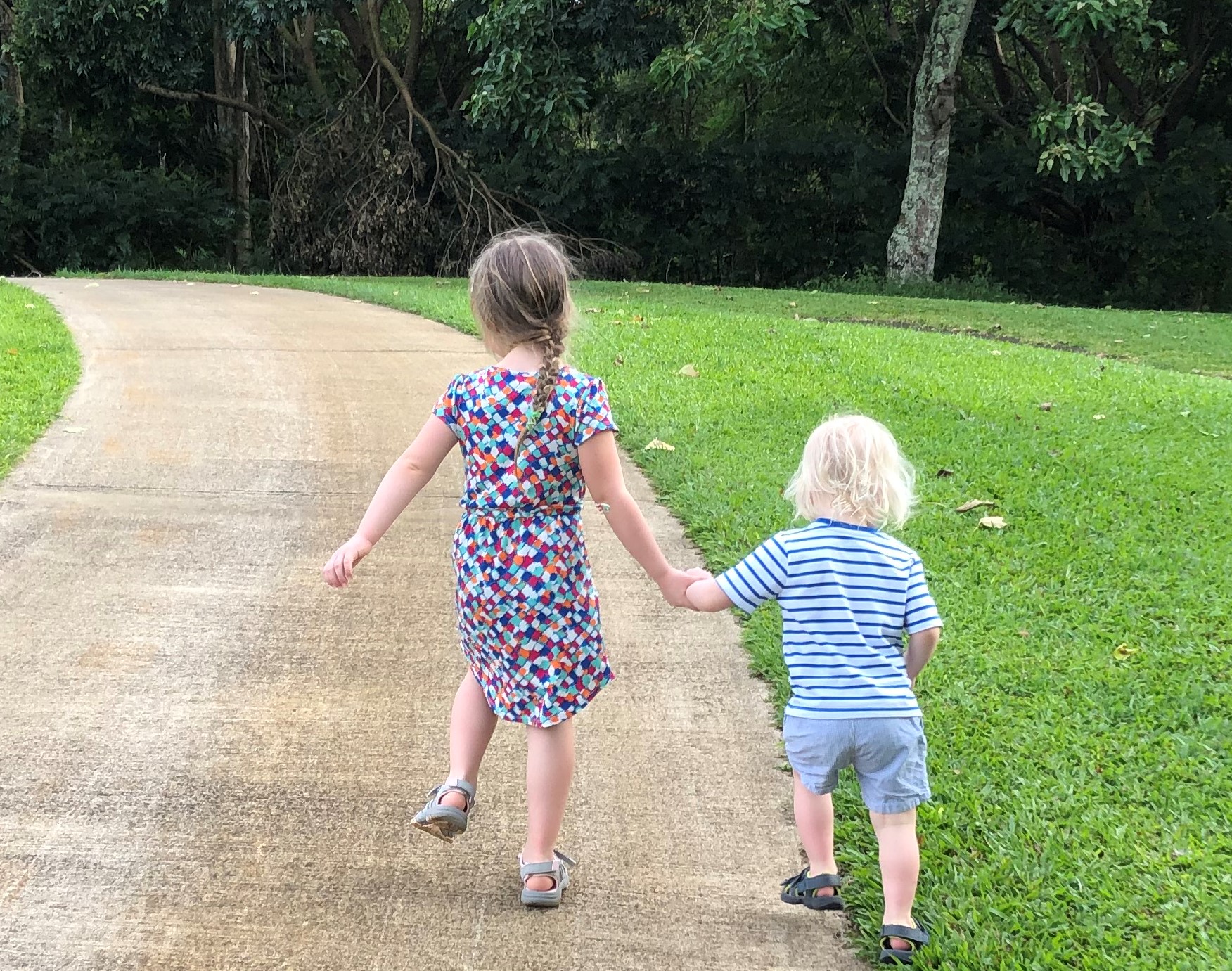
On our walk this evening – just us, the sky, the birds and time…