Awakenings

Glimpses of the Divine in the Mundane

IMG_0280

I came close to leaving the church.  For the past year and a half I have had awakenings that have shook me to my core, I have wrestled with questions that felt like I was being pinned down in the ring.  Like any wrestling match, it has been tense.  I have explored to the ends of  my strength and where the edges of my faith have been.

It all started with a certain sermon from a certain “big name” within the Adventist denomination.  I missed the sermon all-together because of the busyness of my job as a high school pastor and chaplain.  After many people kept asking me about my thoughts on the sermon, I thought I better hear it.  And so, with the age of technology, it wasn’t too hard to find.  While watching it, I was more amused than anything.  I didn’t feel challenged at first by it.  But seeds of doubt were planted.  I began to question my calling.  I took my eyes off of my calling, off of Jesus, and began to look at myself.  I began to view myself through the critic’s lens that certain people within the church were viewing me from.

Then more conversations surfaced.  I found myself in a church for a constituency session – the same church I had grown up in as a child.  I sat there hearing people’s strong resistance against women in ministry, even people who had taught some church school classes when I was growing up…I’ll be honest:  it hurt.  And I felt angry that it hurt because it made me feel weak.  I felt I should be stronger.  So many feelings kept flooding me.  I felt that I had been duped into believing that I was called.  I felt like a kid who had been allowed to cook in the kitchen, only to be later told that my meal I had prepared had been secretly replaced by a more worthy chef.  I felt betrayed.  And I was angry that I felt hurt by this all.  Had I really been this naive?  And then I felt angry for letting it affect me so much – just do your job already!  And I did.  I kept working hard, trying to mask my pain with more work.  But I still felt it.

But then more blows came.  Some people would approach me and tell me to my face that I was a disgrace to God and the church because of what I did (being a female pastor).  The internet became a screaming voice of bigoted comments against women – comments cloaked in Bible verses and “righteous” anger towards women in ministry.  It surprised me, really.  I even received an email that used words that cut me down to the core.  And I began to ask myself:  why am I here again?  Why do I work for this church?  Why am I putting up with this again?

That tension has been there a long time.  To be fair, I have been blown away by the other voices that have risen to the surface in support of me and other women in ministry.  I have been moved by my brothers in ministry who have had my back and who laugh with me about the ridiculous things people have said.  (It’s funny how laughter is a beautiful vehicle for pain and anger).  I even had my administration in the conference I work for personally send me a note stating that I was a valued member of the team.  And the students that I worked for and love so much, I couldn’t leave them.  But I still questioned my call.  I still felt like I was experiencing a death.

And I think I now know what that death has been.  My allegiance to “the church” has died.  Any pull that may have been there for the politics of religion has been slaughtered.  All the “right things to say” to be within the “right circles” has shattered.  The mask of the beast of human religion has been unveiled, and in disgust I want nothing to do with it.

So why am I still here?  Because something else has been surfacing.  And it’s the definition of what church really is. It’s the strengthening of my calling.  I am not here because of “the church.”  I am here because of Jesus the Christ.  I am here because I’ve been created for such a time as this. I am here because I have talents that have been bestowed upon me to make this world a different, better place.  A lot of the things that are happening within churches are wrong, and that’s why I need to stay.  Because if I leave, I am agreeing that I am not called.  If I leave, I am agreeing that the beast of human religion is stronger than the call of the Divine.  If I leave, they won.  If I leave, I am throwing in the towel and the dysfunction that has become the church to so many people will only get stronger.  And so I stay for the sake of the call – to call the church back to its true meaning.

Because, in reality, the church is not defined by what it has been. It is not defined by its location. It is not defined by its statutes.  It’s not defined by the General Conference President.  It’s not defined by Amazing Facts.  It’s not defined by 3ABN. These things can be good, but they do not define church.  The church is not defined by Christian music.  It’s not defined by a political party or a fundamentalist group. The church is not defined by its institutions, conferences and unions.  The church is not defined by the steeple or the tithe intake, or the attendance of people in the pews on the weekends.  The Church is defined by YOU.  It is defined by ME.  Its defined by the calling we’ve been given.  The church is defined by the radical message of Jesus the Christ, who was crucified by religion.  It is defined by radical love – love that is carried in human canisters like you and me.

There is a question I ask myself when I’m in a tough place, whether it’s a place of apathy or a place of indecision, or a place of hardship.  And the question is this:  If this were a movie, and I was the main character, what would I want myself to do in this situation?  And usually I want my character to do the thing that will be most challenging.  If the music was building and in the movie the camera panned in on my character, what would I be rooting for?  I would want her to do what she knows she has been created for.  I would want her to change history.  I would want her to make the hard decisions and then follow through.  For some who have been in my situation, that means to leave.  For others, it means to stay.  For me, that is what I am to do at this point.  And why should I leave – I’ve done nothing wrong.  There may come a time when I am pushed out because of my calling.  There may come a time when I will be denounced not just because I’m a female, but because of the radical love of Jesus’ gospel.  There may come a time when I will be forced to choose between allegiance to the church or allegiance to Jesus Christ – but in all of these instances, I won’t be leaving the church, because the true church consists of people who’s only allegiance is to Jesus’ love and embodying that love to the world.  There may come a time where the decision will be forced that in order to be the true church we’ll have to “leave” the organized church.  Because I know, in many great characters that have come before, that when we follow Jesus the Christ and live His radical love in this world, be ready for a crucifixion.  But for now, in my story, in my journey, my character is supposed to stay within this setting.

I look at the people who have gone before me and who have faced a lot worse and who still pulled through.  I am awed by their tenacity to keep going, to change history, to reveal the evils of mankind and to lovingly encourage a better alternative.  They have brought light to us on our paths.  They are passing on the baton to others who will continue this race.  Their hands are in full swing, ready to release.  Their leg of the race is over, and they need someone to take up the baton.  If I leave, the baton will drop.

baton1

Imagine if the people who started this race had bowed out.  People like: Jesus the Christ.  Stephen the 1st Martyr. The Waldenses.  The Martyrs in all of Christendom. Martin Luther. Ellen White.  St Francis of Assisi.  Mother Teresa.  Martin Luther King, Jr. These just name a few.  These had the fortitude to not be lured by the politics of religion, but to shine the light on what love is, and how that love can change the world.  What if they had left when the going got tough?  What if they had said “Screw this!” and left for greener pastures?  It is because they kept going that we have an example and definition of what this radical love looks like.  It is because they leaned into the storm that we understand what the true meaning of church should be.  Without their example and sacrifice, we would have no way to measure the difference between religion and love.

I’m not sure what the future holds.  But I do know that this calling is my canvas.  This is my studio.  This is my pulpit.  And that I have been created for such a time as this…and so have you.  Regardless of whether or not I will always “work for the church”, this I know:  I will never leave the church because I am the church, and so are you. We, as humans alive at this time, are the church.  I have been called for such a time as this, and so have you.  As someone once said, “let’s stop complaining about the church we have experienced, and let’s become the church that we and God dream of.”

running

Everyone has a soapbox, whether we want to admit it or not.  With the rise of technology, most people’s soapbox is through the online world.  Take Facebook, for instance.  As you scroll through everyone’s status update, count how many of your friends are stating opinions and views on politics, religion, causes, self-promotion, news events, entertainment, etc.  It’s there you can see that everyone has a soapbox.

What exactly is a soapbox?  By definition, it is ” an improvised platform used by a self-appointed, spontaneous, or informal orator; broadly : something that provides an outlet for delivering opinions.”  It seems to come from back-in-the-day, when anyone would use a box or other type of platform, turn it over, stand on it and make a speech in the park or the street on a topic that seemed important to them.  Today, we may not see much of this, but, as I stated previously, we see it a ton online, especially on social network sites, websites, and blogs.

Yet, so many times when we hear the term “soapbox”, we maybe feel a twinge of negativity.  But why?  Perhaps because of the way the term “soapbox” is generally used.  For most of the time, when someone is on their soapbox, it’s as if they can’t shut up about a certain topic.  But can a soapbox be a positive thing?  Can it be a message that carries an essence that this world needs?

In fact, I feel it’s even bigger than that.  We all stand for something.  We each have an opinion.  We all put out a vibe of what we are about.  We all have a soapbox that filters to the world about who we are, what our message is, what we believe in, what we live for, etc.  In fact, could we even go so far as to say that we ARE the soapbox itself??  We are the container of whatever message or energy we exude?  Could we say that we are the platform?  We are the living message – we are the live status update.  We are the soapbox.  The question to ask is, what is our message?  What are we promoting?

soapbox

Let me give you an example.  Recently we were in Venice Beach, California, on vacation.  This place holds a ton of culture, color, and vibe.  As we were walking along the boardwalk with so many other human beings, we came across so much at every corner.  The delicious smells of vendors and cafe’s filled the air with scrumptious aromas.  The breeze carried the rise and fall of tunes from street musicians sharing their gift with bypassers.  Although crowded, the air was alive with the eclectic mix of humanity, summer, the beach, and southern-California life.

As we rounded one corner, the air changed.  You could feel the tension in the atmosphere.  As we got closer, I could recognize the tone and voice inflection of someone preaching through a bullhorn.  I couldn’t understand at first the words this person was saying, but I could tell by the rise and fall of his voice, that he was speaking about hell and “warning” all of us of “God’s wrath.”  As we got closer, I felt the tension as well.  I felt embarrassed, disgusted, and pitiful for this man.  He wasn’t even looking anyone in the eyes.  It was as if, at his core, he knew that this maybe wasn’t the best tactic.  He was reading from a Bible, specifically from Romans 1, out-of-context, referring to all the things that are wrong with humanity.  There were other people around him, somewhat mocking him and holding up signs that had been quickly scribbled on cardboard, stating things like “Satan loves you”.  Not that they believed that, but it was their way of dealing with the tension of the situation.

bullhorn

The energy felt oppressive and dark.  But not from the mocking signs.  It felt “off” because this man had chosen as his soapbox this outlet, this message, this place.  He probably felt like he was a modern-day prophet, warning people of “the wrath to come.”  But he assumed a lot about all of us, and instead of getting to know who we all were, with our stories and experiences, he instead used his soapbox of religious fear to try to get people to turn to his God.  But it was all wrong.   He couldn’t even look his fellow human beings in the face.  As we walked by, and his voice disappeared from our earshot, the energy once again changed back to the beach, the summer afternoon, and the wind in the palms.

That’s one soapbox…

Later that day, we decided to rent bikes.  We rode all the way past Santa Monica pier, and towards Malibu.  The afternoon was waning, and the sun began it’s preparation to set.  We turned our bikes around to head back towards our hotel.  The air hung with a peaceful stillness as we sailed along the bike path that snaked it’s way along the seashore.

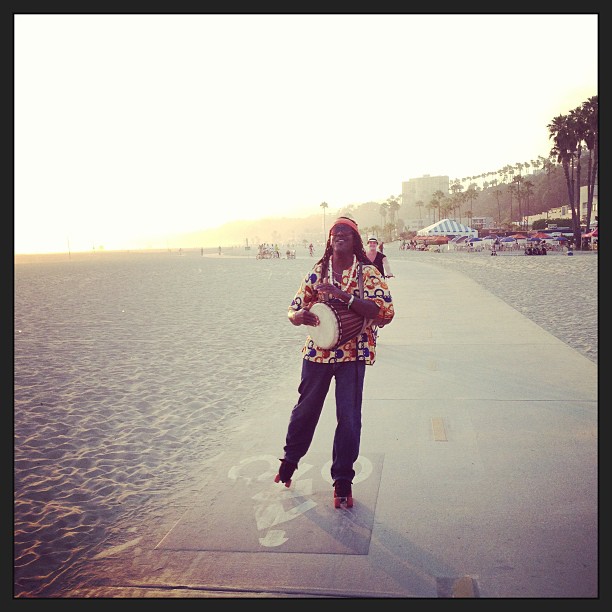
Suddenly, a man joined us on the path, roller-skating.  He held a drum in his hands and skated in rhythm to the beat he played on his drum.   There we were, the sun sinking behind the Malibu hills, the sea crashing beside us, and the wind in our hair.  His beat was almost a pulse of the earth – a pulse of our beating hearts.   Then he began to sing.  His song was simple, really.  He made it up as he sailed along the shore.  He sang a love song.  Not sure who it was to.  But it felt like it was to all of us.  It felt like it was to the sea, the sun, the day.  To all of humanity.  He kept saying, in beat to the rhythm of his drum and in sink to his roller-skate-step, “I love you baby…Cuz I need you in my life…I just want you to know…That I love you baby…”  With the gulls soaring above us, and the day dissipating into evening, it felt like we were being carried by his song.  I literally felt like God was singing to me.  I slowed my pedal and rode behind him, for miles.  A soapbox of love being carried on roller-skates.

It was so cool to see the expressions on people’s faces as we neared different crowds along the path.  It was amazing to see them first catch the sound of the beat, to hear his song on the wind.  Startled, many of them would look around to see where it was coming from.  Many of the crowds were packing up and heading to their parked cars.  Some looked tired and exhausted from the long day in the sun.  Some families were even bickering.  But then they all stopped as they heard the song on the wind.  As the roller-skates inched closer, and the song become louder, it was amazing to watch their faces change.  They became filled with wonder, peace, and respect.  It was if they became children again.  It was as if they were all thinking “that’s so cool – I wish I was free enough to do that.”  It didn’t matter who saw him – all different ethnicities, all different ages, genders, and walks of life.  Everyone had that look on their face – the look of admiration, tranquility and a yearning for more.  It was as if they were reminded of the magic of life – the beauty of a simple day at the beach – the wonder of togetherness.  It was beautiful.

The time came that we had to reluctantly pass him to get to our destination.   We asked if we could get his picture, and he nodded, in mid-beat, with a smile on his face.  He looked us in the eyes, and shared a nod of commonality.  As we went our way, his song slowly melted away into the twilight air.  But the beautiful energy of that encounter stayed, as if the heartbeat of the universe carried us along on our separate journeys.

1016764_10200896957019000_736105771_n

Our friend on the boardwalk, roller-skating, playing his drum and singing his song

That’s another soapbox…

We all have a soapbox.  We all carry a message.  In essence, we are a soapbox to this world.  The question to ask is, what is your message?  Is it one of fear, judgment, and division?  That’s one mindset – one soapbox.

Or is it one of love, peace, and a nod of human respect, even a celebration within our diversity?  Because whatever message we choose to emanate, that will be the pulse which carries darkness or light to this world.  The choice is ours.

We all have a soapbox.  We all carry an energy.

I, for one, am sick and tired of the bullhorns.  Perhaps it’s time to pick up a drum, lace up our roller-skates and deliver a love song…

Certain clichés have really been annoying me.  They always have, but lately it’s like anytime any of them are used, its as if someone turns up the volume.  Like nails on a chalkboard, they screech in my ear, and cause my inner spirit to shutter in disgust.

I guess its cuz you can’t really box the spiritual.

You can’t copyright life-essence.

You can’t capture the sea breeze in a container.

Maybe that’s why I don’t refer to myself as “Christian”.  It’s just another cliché, with certain meanings and assumptions stuck to it like old, used bubble gum.  I don’t even like referring to myself under my denomination’s name.  Because it’s just another box, just another set of opinions, varying in different degrees depending on who you ask.

I have titles – so do you.  But I don’t like these, either.  More boxes.  I am a woman.  But what does that mean?  It depends on who you tell that to – everyone has their expectations of what it means to be a woman.  Some would say to be a woman means that I am feminine, (another box), or maybe feminist (another box), or that I need to dress a certain way, or practice a set of social norms that will bring me into the presence of other women, or be respected by men.  More boxes.

I am a wife.  But what does that mean?  Once again, it depends on who you ask.  More boxes.  Some would say a wife means I need to cook, clean, have babies.  And then if I were to become a mother, more boxes:  will you keep working?  Stay at home? where will your child get educated?  How will you discipline?  Etc. etc.

I work.  I won’t tell you what my job is, because once again I will be squelching myself into a box.  But for discussion’s sake, here goes:  I am a “pastor”.  Oh you know the boxes for this one just piled up!  Not only are there boxes from society, but even within my own denomination, not to mention the box just got smaller because of my gender, and I could go on and on.

Why do we create boxes?  I guess they are necessary, to a certain extent. I guess they help with communicating with others who we are and where we are coming from.  It’s important to know that I am female, and what my age is, my ethnicity, etc.  I guess?  But perhaps the problem comes when we view the world through the boxes we’ve created or experienced.  When we peg others and place them within the confounds of our viewpoints…our boxes.

But have you ever tried to catch the wind in a glass jar?

Have you ever cupped the brilliance of a sunset in your palms?

Have you ever formulated the butterflies in your stomach when you first fall in love into an equation?

Have you ever manufactured the pain of your tears into a concoction that others can taste?

Why do we create boxes?  I’m so tired of them.  Aren’t you?  Or are we so used to them that they define our society and our very reality that we can’t even see them anymore?  Are boxes based on truth?  Or could it be that they are formulated ways to deal with our own fears and insecurities?  Think about this:  How much of your reality do you have to explain by using box-terms or clichés?

Have you experienced outside-the-box living?  How?  What are the boxes you feel or experience?  What are the boxes you place others in?

The next couple of blog posts I will be divulging more on this topic.  But do share:  how do you live outside the box?  Because remember:  breath is an ongoing process of life, and if at any time it is boxed, you will begin to suffocate.  To live means to leave the confines of the box.

Right away I noticed him.  His head wrapped in a turban, he fit in with all of us misfits, all of us travelers on this journey of life, religion, politics, and survivors of the expectations that arise from ourselves and others.  Under the turban was a young man seeking for answers, running and playing the games with the rest of the youth, and just a fellow human being alive at this same time in history.  The light in his eye, the honesty of his body language, spoke volumes.

I was one of the facilitators at a Christian youth retreat for the weekend, and he had come as a participant with his school.  Even though he went to a Christian school, his religion was Sikh.  Sikhism is a beautiful religion.   “Sikhs believe in the equality of humankind, the concept of universal brotherhood of man and One Supreme transcendent and immanent God.”  And his persona lived that.  It was so cool seeing him interact with the youth of a Christian religion.  His presence was a reminder that we are all the same, regardless of religion, race, political standing, or economic place in this country and world.  In fact, his presence and exuberance of life sparked the unspoken question of why do we even have such borders around different religions – and even tighter borders around different denominations within Christendom…and dare I say, even tighter borders within the same denomination?

On our last day of the retreat, I stood at the back of the room helping with supervision of the teens as they had their last meeting together.  There was a band leading out in music from the front, and all the teens were singing loudly, revived and rejuvenated from the weekend.  The sound was beautiful, really.  The song that they sang was “How He Loves Us”.  The lyrics of the chorus say over and over “He loves us, oh how He loves us, how He loves us so…”   And then I saw him.  Singing his heart out.  With everyone else.  And in that moment a million things happened in my brain all at once.  It was crazy, really.

It was as if I saw a future picture of a time when we will all be in a place of peace – you could call it heaven, I guess.  And we were all singing that song, “How He loves us so”.  And we all – human beings from all walks of life, religion, sexual-orientation, political standing, dress, culture, mistake-ridden-life, – were united as one under this LOVE.  The thing that united us was not our belief, or any of the above categories.  The thing that united us was this crazy LOVE that takes us beyond ourselves, beyond our agendas, beyond our “I’m right” mentality.  There were no walls, no borders.  I could see us all – Buddhists, Christians, Taoists, Muslims, Jews, Sikhs, Hindus, Agnostics, – I could see us all gathered there.  We were still in our different regalia that demonstrates our belief – but we weren’t looking at it or were distracted by it, nor were we trying to prove something by it.  We were all facing God, the One who is LOVE, all amazed that we are indeed Beloved…and it is THAT fact – we are ALL Beloved –  that united us.

Isn’t this the beautiful truth – We are beloved.  He loves us.  All of us.  Regardless of our crazy arguments.  Regardless of our experiences. Regardless of our brokenness.  He loves us.  He sees beyond our man-made disguises.  He sees us.  The beauty of who we are – sacred, created, truly a universal brotherhood of humanity, all drawn and existing because of the One Universal LOVE – the Being Who created us all.

It all came to me in a chorus of a song.  But it felt like I had been lifted into that moment.  It was beautiful, and I truly felt in awe of God. And then I asked myself – if we claim to follow this Being who is described as LOVE (see 1 John 4:16), then why do we not see our fellow humankind the way this God, this LOVE, sees us?  Indeed.  Because the fact is, He loves us.  All of us.  Oh how He loves us.  It’s time we did the same.

“With this Love, Bitterness becomes Honey

With this Love, Copper becomes Gold

With this Love, Dregs become Wine

With this Love, Pain becomes a Healing Herb

With this Love, Death becomes Life

With this Love, The King becomes a Slave.”

– Rumi

Questions. I love questions. I see questions as ideas waiting to be realized, or information that is about to be birthed. But questions can be scary for some people, because the foundation of what they believe to be true can be shaken. (Which is funny, because if it is the truth, no question will be able to change it.) I love questions. I believe that questions hold the tools for living fully and walking this journey undaunted.

One of the parts of my job that I love is to teach. I love high-school age students because they are not afraid to ask questions. The questions they ask in class and outside of class are always so inspiring and mind-blowing. I am always encouraged by their questions, because to question shows you are willing to grow. To question shows you are humble enough to admit that you don’t understand it all. And to question is to show courage that you believe there could be something better. Questioning is one of the biggest ways that we show we are spiritual creatures, capable of choice and able to find or create a better answer, if one does not exist.

As a teacher, there is this thing called Bloom’s Taxonomy. Bloom’s Taxonomy is a way to measure how a student learns, as well as what level of learning and thinking they are at. To be a good teacher means to encourage your students to be constantly growing higher in their level of thinking. Here’s what Bloom’s Taxonomy looks like:

bloom_taxonomy

As you can see, the first level of thinking and learning has to do with basic information, or “Knowledge”. In other words, know the facts about a subject and be able to remember what those facts are. The second level, “Understand”, deals with being able to understand the subject matter. In other words, how do you describe or explain, and how does it make sense. The third level of Bloom’s Taxonomy, “Apply”, is measuring whether the student can apply what he or she has learned and relate it to real life. These are the lower levels of thinking and learning. They are important, especially when learning a new topic or subject. But they are just lower levels and therefore stepping stones in getting to the higher levels of thinking. The next 3 levels of Bloom’s Taxonomy are considered the higher levels of thinking and what all good teachers should strive for their students to attain to.

The fourth highest level of thinking, “Analyze”, has to do with the student being able to analyze the material. In other words, being able to contrast or compare it with other materials, and be able to defend, or choose, the right answer and then explain why it is the right answer. The fifth highest level of thinking is to “Evaluate”. This means to basically be able to take the subject and defend it, critique it, justify it, support it, and possibly prove it, etc. (Sounds a lot like asking questions, right?!) The highest level of thinking is to “Create”. In other words, to be able to take all the knowledge you have from all the previous levels, and put it into a product of your creation. This means that after the Evaluation part of thinking, if there was anything that needed changing or improving, you now change it and improve it. This is the highest level of thinking because it uses all the faculties of the brain to take the information and not only apply it, but create a way of expressing it to the world, as well as making it a part of yourself. If you are a good teacher, this will be your goal in getting your students to strive for, not only in the subject matter that you teach, but in life as well.

knowledge

So here’s the question: how are we doing in regards to Bloom’s Taxonomy in the Church? If the highest levels of thinking happen at the 3 higher tiers of Bloom’s (Analyzing, Evaluating, and Creating), are we there as a church? Do we encourage and gently push each other towards these higher levels? Or is the church afraid of these higher levels of thinking? Is the church afraid of questions? Is the church worried what would happen to the truth if we promoted all people to not just be Analyzers and Evaluators, but ultimately Creators as well?

Don’t get me wrong. The lower levels of Bloom’s Taxonomy are very important. They have to be in place so that the higher levels can exist. If someone knows nothing about a subject, you can’t ask them to create or analyze it, without first learning it. But here’s what I see is the problem: We are stuck in the 3 lower levels of Bloom’s, when it comes to the Church, Spirituality or Religion. We focus on what you know, whether it’s true, and memorizing those facts. The church encourages people to understand truth – to describe and explain it. The church even encourages people to apply truth to their lives… and then we repeat those lower levels and never seem to move up to the higher levels of thinking and being. It seems that there are those who get very nervous when the 3 upper levels of thinking begin to take place within the church (which they naturally will, if a person is being encouraged to grow).

There are those who are very scared or worried when some begin to question, which, by the way, is just another form of Analyzing and Evaluating. There are some who will let others Create, just as long as they stay within the lines of the man-made box of politics and religion…which begs the question: Is that really creating? It’s almost like the scenario of a parent giving a child a coloring book. The child knows how to color, etc. But then the parent holds the child’s hand and guides the coloring. Is that creating? Why are some so afraid of questions, of growth, or of improvement?

Our church, and the Church at large, is ready for something. It’s ready for growth. In fact, the change, the spirituality, is happening. Some of it is happening within the church. And change, spirituality, higher levels of thinking, are happening outside the church, as well. Which raises the question: Is the church only contained within the walls of man-made institutions? Or could it be that it is growing beyond the walls of the box, because, as every good teacher knows, we were all made to live, know, and process on the higher levels of Bloom’s Taxonomy. And if the box does not promote that environment, it will still happen, but it may happen outside the box. We were all made to take what we have and know, and create something better. In education it is encouraged – that is, if you’re a good teacher. It’s high time we encouraged this within the church as well. If we don’t, the church will be stagnant. Could it be that it is already? But then again, could it be that the Church is alive and well – but it lives where the questions live, and it thrives where creations happen? Just some questions to ponder…