There are moments of the Sacred that surround us everyday. They scream at us, or whisper at us, or dance around us. Most of the time we are unaware of the dance, of the whisper. At times we hear the scream, or see the miraculous within the mundane. Regardless of us seeing it, it still is present, every moment perhaps. There are times when the sound bites get through. There are moments when my eyes are lifted from my stressful routined-existence and I see something beyond myself. I see something Sacred.
Yesterday we were in San Francisco for my husband’s birthday. The day was perfect, with clear skies and no wind. We ran all over the city, checking out Coit Tower, Union Square, Fisherman’s Warf, and finally ending the day with a trolley ride back to our parked car. The sun had set, and the cool air caused us all to snuggle a bit within the rattling cable car. There was a satisfied stillness to the ride, as we all sat at the end of another day of life, riding back to all our different destinations, stories, journeys, histories and lives.
Then I saw her. Probably no more than 3 years old, her big eyes taking in all of life. Her curls danced a frame around her face that painted a hint of kindred kindness, steeped in innocence. She sat there next to her mom, crossed legged on the uncomfortable wooden bench that is the cable car seating. She sat like an old soul with the openness and awe of a fawn.
Then the moment happened. She looked at me. Into my eyes. Across the cable car from her corner besides her mother and grandfather, she saw me. Our eyes locked. She looked at me with a curious kind of wonder, looked right past my adult masks that I’ve learned how to hold up and claim as my identity. She looked at me. I smiled at her. And then she smiled at me. But it was more than smiling at my face. She smiled at my soul. She saw me, and seeing that I saw her, she smiled back. That was it. But it was so incredibly powerful. In those 3 seconds she said more to me than has been said in a long time. She saw my true authentic self and smiled with that awe and wonder still written all over her face. She saw the human in me. I wasn’t a category, or a job, or a social status, or a religion. I was a fellow human being. And she recognized that beauty and returned a smile, as if we were in on the secret that, yes, indeed this life is beautiful. She showed me God. She exemplified the Sacred in that moment.
On a cable car? In San Francisco? With just 3 seconds so much can be said? The innocence of an exchanged look and smile of reverent commonality. A shared grin of “this is life, and it’s a beautiful ride, isn’t it?” A gaze that spoke the blessing of Namaste, which means, “The Divine in me recognizes and honors, the Divine in you.” I had encountered a moment of the Sacred from a 3-year-old fellow-traveler.
The Sacred is all around us. Have you seen it’s colors painted within the threads of your day? Have your ears heard the rise and fall of the song? Has your soul sensed the pulse of the dance, pulling on your routine schedule and challenging your steps to move to a different beat? The Sacred is all around us, and perhaps, especially in the chaos.
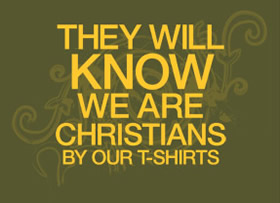
There’s this t-shirt out there that says “They Will Know We Are Christians by our T-shirts.” Which is kinda funny, and kinda sad.
It seems lately that the first part of this phrase could go many different directions. Let’s try some:
They will know we are Christians by our…Facebook Updates
They will know we are Christians by our…Christian Quotes
They will know we are Christians by our…Vegan Diet
They will know we are Christians by our…Bumper Stickers
They will know we are Christians by our…Political Affiliation
They will know we are Christians by our…Calling Out Sin
They will know we are Christians by our…Allegiance to the Church
They will know we are Christians by our…Tithe-paying
They will know we are Christians by our…Dress-code
They will know we are Christians by our…Websites
They will know we are Christians by our…Serious Demeanor
They will know we are Christians by our…Conservative Stance
They will know we are Christians by our…Liberal Stance
They will know we are Christians by our…End Time Prophecy
They will know we are Christians by our…Jesus-Music
They will know we are Christians by our…Righteous Deeds…oh wait.
They will know we are Christians by our…Bickering and Fighting…I mean…
They will know we are Christians by our…Plastic Smiles…uh-oh…
They will know we are Christians by our…Condemning of Others…ouch…
They will know we are Christians by our…Having to Always be Right…
They will know we are Christians by our…Having a Proof Text to Win an Argument…
They will know we are Christians by … How much we Talk about Hell…
They will know we are Christians by our… Picketing Signs and Shoving Pamphlets at People
They will know we are Christians by our… (What would you add?)
Even though the last few were a bit facetious, unfortunately they ring way too true. What are Christians known for? As Mahatma Ghandi said, “I like your Christ, I do not like your Christians. Your Christians are so unlike your Christ.”
As we know (or should know), the phrase actually goes like this: “They Will Know we are Christians by our Love”. Ah! That’s it! Love. The phrase comes from a song, which is taken from the Bible verse John 13:34, 35 which says
“So now I am giving you a new commandment: Love each other. Just as I have loved you, you should love each other. Your love for one another will prove to the world that you are my disciples.”
What’s interesting to me is who Jesus is talking to. The context here is everything. The group Jesus is talking to are His disciples in the upper room. Many people have looked at this verse and this phrase and have said that the world will know we are His disciples if we love. And so Christians focus on loving the world, which is good! But loving the world and everyone in it is already a given if you’re a follower of Christ. The context is right in the passage itself: Jesus is referring to people who follow Him, loving other people who follow Him. Jesus says, “Your love for one another will prove to the world that you are my disciples.” It’s already a given that we are to love the world and everyone in it. But it is an entirely different thing to love each other. Let me explain.
Right now in many churches and denominations we have so much fighting and dissention. In fact, it’s not just in religion, it’s in politics as well! Just recently after the election in the United States, there was talk of secession because certain voters in certain states felt that they could not belong to the United States of America because their political party looked like it had lost. In some churches and denominations right now there is huge infighting based on discussions regarding gender roles, worship style, homosexuality, unity, and the list could go on and on. That’s why we have over 35,000 denominations within the Christian faith today. Because we have never learned to disagree well. Dare I say, we’ve never learned to love.
The other interesting thing about the context of this verse is that Jesus has just washed the disciple’s feet at the last supper. This is a tradition we do in the Adventist church to show humility and love to one another, and to remind each other that the only One lifted up higher than any of us is Jesus Christ. That my opinion is not higher. My stance on a certain issue is not higher. But that we are all under Christ and therefore brothers and sisters. We are family.
And notice also that Jesus calls it a “new commandment.” It looks like He knew it would be a difficult thing to do. He needed to show us that this is not a small issue to Him. This is big enough to make it a commandment. It’s as if He knew we would get our focus on nit-picking others and pointing fingers and fighting to be right, and we would forget how to love.
On the sermon on the mount, Jesus also refers to this mindset when He says,
“You have heard the law that says, ‘Love your neighbor and hate your enemy. But I say, love your enemies! Pray for those who persecute you! In that way, you will be acting as true children of your Father in heaven. For he gives his sunlight to both the evil and the good, and he sends rain on the just and the unjust alike.” – Matthew 5:43-45
Once again, most people apply this to the “world” versus “followers of Christ”. But what if Jesus was also referring to those within the walls of Christendom? What if my “enemy” is the one who disagrees with me and is persecuting me because of our differences?
One more verse that is of interest to me comes from 1 John 4. The whole chapter is amazing, but check out these verses:
“Dear friends, let us continue to love one another, for love comes from God. Anyone who loves is a child of God and knows God. But anyone who does not love does not know God, for God is love. … If someone says, “I love God,” but hates a Christian brother or sister, that person is a liar; for if we don’t love people we can see, how can we love God, whom we cannot see? And he has given us this command: Those who love God must also love their Christian brothers and sisters.”
– 1 John 4:7, 8, and 20
It’s so easy to love and commune with those who agree with us and think the same way we do. But what about those who don’t? It looks like God wants us to learn how to listen to others and extend grace to each other, especially those we don’t agree with. It appears from these passages that God desires us to love others, and especially each other. Especially those with whom we find it so difficult to like. Because in all reality, when the world sees a group of people who love and respect each other, even in the midst of disagreeing, there is something divine about that. Because it is not human. It has to come from a greater source. This will prove, not only that we are His disciples, but it will also prove that perhaps a God of Love actually exists.
I’ll be honest. This won’t be easy. But maybe that’s the point. I’ve been hurt by so many “Christians” within my own denomination, and I know you have, too. But Christ is telling me to love. He’s telling you to love. What if we actually took Jesus seriously and did it? To love each other (instead of competing to “be right”). To pray for each other (instead of praying against each other). To honor each other by “washing each other’s feet” (instead of gossiping about how aweful the other is). To pour out our life for each other (instead of our anger and malice). To not let bitterness control us (but instead let LOVE compel us). Oh God of LOVE, be the very pulse in our wrist, the watchword on our tongue, and the spring in our step. As the old song goes, “what the world [church] needs now, is Love, sweet Love!”
(in light of the discussion, we’ll end with that great tune)
Have you ever been disenfranchised with Church, Christianity, etc? I have. I have come so close to “leaving” because I’m so fed up with all the politics, all the drama, all the lines drawn in the sand by professed followers of God. I’m so tired of all the expectations that can be put on people. Sometimes it seems that “saints” within the church expect more from people than they do from God. When this happens it’s clear that the church has gone from being a movement and has turned into an organization that must self-preserve.
Recently someone reminded me that “the gospel is not safe anywhere, especially in church.” This gospel, or good news, is radical. It’s life-changing. It can’t be contained. It can’t be dwarfed into a doctrine or explained within a fundamental belief. Think of it this way: How do you box air? How do you describe music to someone who’s never heard the sound before? How do you express in words the color of a sunset to someone who has never been able to see with their eyes? How do you whittle down the gospel of love into 28 beliefs, or cram it into a creed? It may be a good try and you may hit parts of the gospel, but it is ultimately quite impossible. In fact, when we do that, could it be that we begin to lose the very essence of the gospel? Could it be that it slips through our fingers like trying to cup all of the oxygen into our hands?
What is the gospel? It is the scandalous truth that there is this Love, this Grace, that is beyond any human achievement. It’s given everything for us and is constantly compelling us to surrender to it, to look beyond ourselves and give this Love and Grace fully to others – regardless of who they are. I believe it was made manifest to us beautifully by the life, death and resurrection of Jesus. It is anti-ego, anti-agenda. It is this sacredness that is yearning to pick us out of the mundane of our routined-existence and awaken us to the reality that there is a Being Who not only loves us, but is constantly wanting to rescue us from our kingdom of selfishness, and carry us into an awareness of a new reality about a kingdom of love and a freedom from the darkness that surrounds us…including the darkness of religion. The gospel is this crazy movement that is the essence of a life-force that brings the world, the entire world, hope. It embodies Love to every single creature on this spinning earth, and that love is more than just a feeling or a mere belief – that Love will manifest itself in actions to every creature, because that is what it is at its very core. So if people are filled with this Love, they can’t help but BE that movement of love to their world, wherever they may be. This love has the potential to turn our world upside down!
This reality, this gospel, is dangerous – especially to religious people. When you think about organizations, corporations, companies, etc., the people who work within them can become religious about the company itself, and lose sight of why it even started. They can protect the building and corporate offices, and end up losing the essence and vision of why it was created in the first place. Religion protects and guards – Spirituality pulses and moves. The gospel is dangerous to people who have to protect an organization because the gospel, aka LOVE, or the SACRED, threatens those who have built their identity and foundation of belief on ideas instead of on the Spirit. When we look at history, many religious organizations have referred to this gospel movement as “apostasy.” The definition of apostasy is ” the abandonment or renunciation of a religious or political belief.” And so, maybe many religious people are correct to call the gospel an apostasy – because Love, Grace, and the Kingdom of God are a sort of Apostasy – they go against human thinking of self-preservation and man-made ideology. The gospel can’t be copyrighted. It can’t be claimed by a group of people, because it claims all people! We just respond – that’s the crazy movement of the gospel of love and grace! It’s like trying to patent water – impossible. We just respond to its existence and thrive off of it.
The church should be the place that helps to vehicle this gospel to every nation, kindred tongue and people – no signing of papers to join our company and start paying club membership fees. Just trust the gospel to do what it does – draw people to it, like an oasis in the desert – free and available to all. The church should be the place to let everyone know that the oasis exists. Unfortunately the church has, at times, fallen short. And so the church needs people who are willing to stand and shout it from the rooftops (or steepletops) within these man-made buildings, corporations, and companies called “church”. I would even go so far as agreeing with Jesus (Who was guilty of apostasy by the church of His day), by stating that perhaps there are people who are not “in church” who are getting into the kingdom of God ahead of the religious people. It’s possible to be religious about church, but deny the gospel (see Matthew 21:31). In fact, could it be that the church is too many times holding the gospel hostage, adding clauses, lines to sign, policies to vote, amending articles, etc? And so those who are outside the confines of church politics have the freedom to be an avenue for the gospel to fully express itself.
So it is that at this time in my life, I will choose to preach – experience, live-out, shout out, step out-side-the-box – yes, I will preach this gospel! Especially to the church. But I am also aware that those who have done this (Jesus, Luther, many of the Reformers, etc) have been crucified in one way or another. The gospel is dangerous! It is scandalous. The gospel is not safe anywhere. May God give me the strength to never be ashamed of the gospel – especially in church.
Have you ever noticed that a lot of times Christian music is its own form of Christianese? There are a lot of very talented musicians out there with some great songs, but sometimes those songs are just Christianese phrases put to music. Not only the lyrics can seem Christianese, but the style of music can be Christianese as well. Have you noticed that it seems like a lot of Christian praise songs just sound the same?
One of these songs that I have always had a problem with is Our God. Our God at first is a catchy tune that sounds like the generic praise song. But I’ve always had a problem with the chorus of this song:
Our God is greater
Our God is stronger
God, You are higher than any other
Our God is healer
Awesome in power
Our God, our God!
The problem I have, other than the fact that it’s just another praise song, is the word “our”. It just sounds like a school yard chant “Na na na na na na, Our God is greater than your God!” And maybe I’m just overanalyzing it. To me it takes the emphasis off of God and onto “our”. Our brings exclusion. It brings seperation. Even though the tune itself is Christianese, even if the lyrics were “God You are greater, God you are stronger…” etc. it would be so much better. Whenever this song is sung I can’t sing it, because all I hear is exclusion. And if God “so loved the WORLD…” He is not an exclusive God.
I want to touch briefly on the sound of Christian music and how most of it sounds the same, thus becoming its own form of Christianese. Recently I was at a Youth Leader’s Convention and there were different praise bands and musical artists. It was interesting to see and hear how most of the praise music just sounded the same, filled with Christianese phrases and tunes that sounded genre-specific to middle-class church-goers. To be honest, I was kind of getting annoyed at the sameness of it all, as well as the exclusive lyrics and phrases. But then one morning everything changed.
I came into the convention hall and there was a sign on the outside that read “Please enter in silence.” As I made my way towards the front of the place, the lights were dim, candles were lit, and there was a realness to the atmosphere. The musicians they had were unlike any I had heard at a Christian setting. The stage had a keyboard, guitar and drum set, but also violins and cellos and when “the band” came out you could tell it was different.
Instead of being the Christianese rock stars of the Christian church-goer’s bubble, there was an authenticity to the music and even their presence. I was brought to tears and felt for the first time in a long time within a Christian setting an authenticity that was spiritual as well as healing. I felt a piece of God. Instead of singing about a Christianese-experienced God, I felt like I was given permission to be me in the presence of a God who meets us all in the authenticity of our own experiences. A God who weeps with us. A God who is perhaps annoyed with the hypocrisy of praise and just wants to BE with us and hear us and see us for who we really are in whatever situation we find ourselves to be. A God who is not exclusive, not cheesy, not defined or confined by Christianese phrases or lifestyle. A God who is Emmanuel – God with us, all of us, all the time.
Which makes me question my life. If my life were a song, what would the sound be? Would I be a generic tune, just sounding like every other Christianese representative? Or would my life be one of invitation to everyone around me to be real, to seek authenticity, that the journey is one of brokenness and healing. Which begs the question: what kind of God do I worship? Because most likely that is the God that I extend to others. I hope our lives will be songs that are out-side-the-box. I hope our lives are the tunes that resonate with the authenticity of every beautiful and sacred creation, inviting a place of relief, acceptance and healing. And ultimately, may our lives not be lived within the box of Christianese.
Here is a sample of the music I heard that morning. The group is called The Brilliance and all of their pieces are real, honest and their genre is out-side-the-box for being a Christian band. Their website is http://thebrilliancemusic.com/



 Awakenings